

I’ve been thinking a lot about the current debate in Congress over Affordable Care Act subsidies: why Democrats want to extend and expand them, and why most Republicans don’t. On the surface, the argument is about subsidies themselves. But the more I thought about it, the more the debate felt oddly narrow.
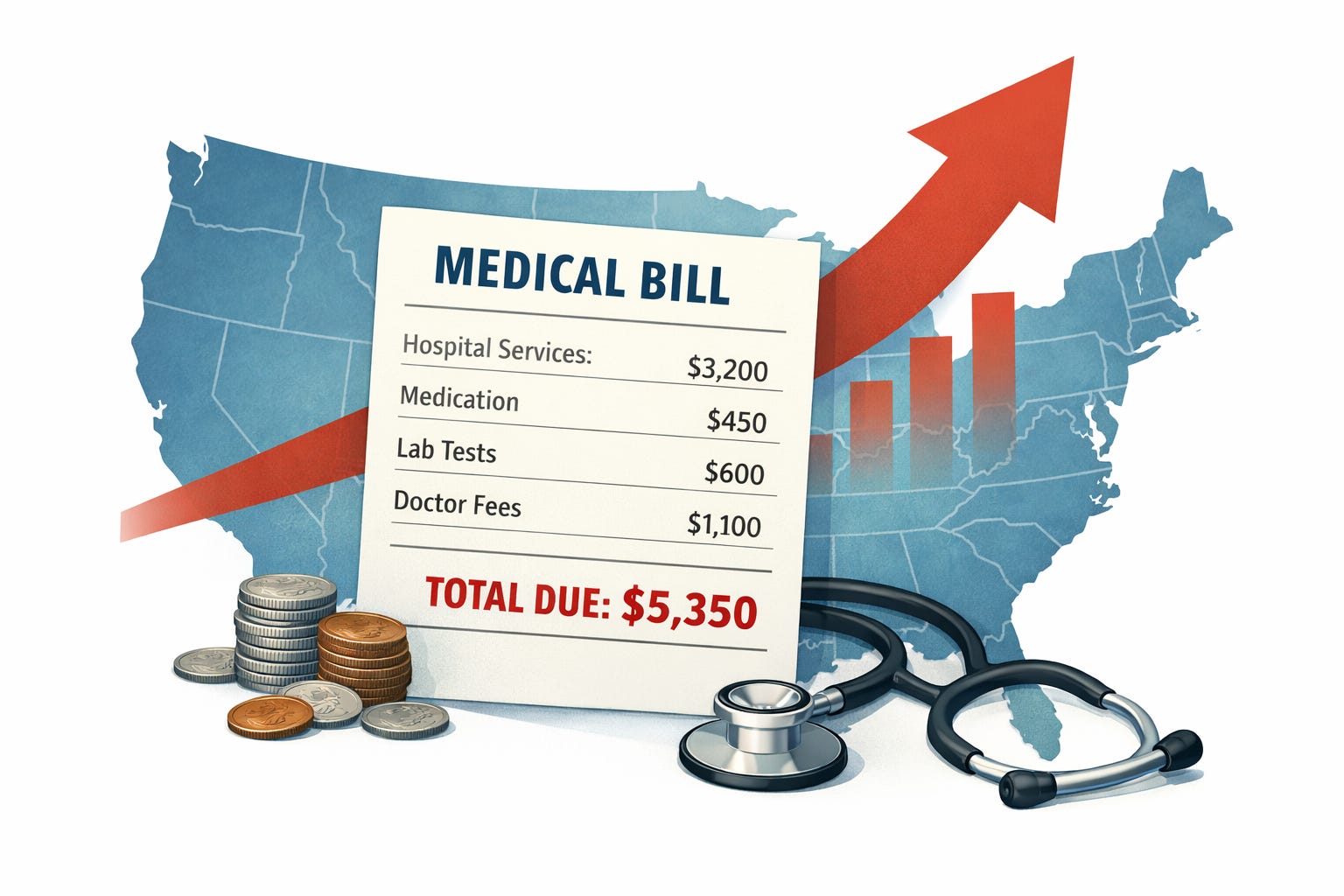
Subsidies don’t exist in a vacuum. They rise because premiums rise. And premiums rise because health care costs keep climbing.
I’m not a health economist. I’m a longtime writer, former journalist, activist, and citizen who’s been watching health care debates play out for decades, often with more heat than clarity. So I started by stepping back and asking what I thought I already understood and whether that understanding really held up.
A few assumptions stood out:
That private insurance companies often add cost rather than reduce it
That publicly financed systems in other countries manage to cover everyone at a lower overall cost
That standardized billing and predictable payment rates, like those used in Medicare and other public systems, are not radical ideas but established ones
Those assumptions mostly held up. But looking at them more closely also helped clarify something important: ACA subsidies aren’t driving rising health care costs. They’re responding to them.
In other words, ACA subsidies are growing because private health care costs keep rising. And they keep rising because no one with real pricing power is allowed to control them. Subsidies don’t cause the problem; they compensate for it.
At bottom, the goal of health care financing shouldn’t be complicated. People should be able to get the care they need, when they need it, without fear of financial ruin. Cost control matters—not to protect profits or ideology but to make that basic promise sustainable and fair for everyone who pays into the system.
With that goal in mind, it’s worth asking a more fundamental question: What’s actually driving health care costs higher—and why subsidies have become such a political flashpoint?
It’s mostly prices, not use
Health policy researchers have long noted that Americans do not use significantly more health care than people in other wealthy countries. But what we do pay is far higher—for the same hospital stays, procedures, tests, and drugs—compared with other wealthy countries.
Prices in the U.S. are higher because they are negotiated mainly behind closed doors between private insurers and increasingly consolidated hospital systems. In many regions, hospital systems have little real competition, which gives them enormous pricing power.
That’s not a free market working well. It’s a market failing.
Administrative complexity adds real costs
The ACA expanded coverage, but it did not simplify the system. We still rely on the “pre-existing conditions” of multiple private insurers, each with its own rules, networks, billing codes, and approval processes.
Studies consistently show that hospitals and doctors must maintain large administrative staffs just to navigate this complexity. Those costs don’t disappear. They are passed along in higher charges, higher premiums, and higher out-of-pocket costs.
Profits are extracted at many points
It’s not just insurance companies. Over the past two decades, private equity and corporate ownership have expanded into hospitals, physician practices, emergency medicine, nursing homes, and specialty care.
These entities are often under pressure to generate returns, which can mean higher prices, aggressive billing, and less tolerance for unprofitable services. Again, those costs don’t vanish; they show up in premiums.
Inflation matters, but it’s not the main story
General inflation and rising labor costs have played a role, especially since the pandemic. But health care costs were rising faster than inflation long before COVID. Inflation may accelerate the trend, but it didn’t start it.
What about government involvement?
This is where the argument often flips backward—and where the facts may surprise some people and annoy critics.
As Medicare’s experience shows, when the government sets prices, cost growth has been slower, administrative costs are lower, and providers still function. Where government is barred from setting prices, as in much of the private insurance market and prescription drug pricing until recently, costs have risen faster.
In other words, the absence of public price-setting has contributed to higher costs, not restrained them.
Why subsidies still matter
Given all this, allowing ACA subsidies to expire would not “fix” health care costs. It would simply shift those costs onto individuals and families — through higher premiums, higher deductibles, medical debt, or loss of coverage altogether.
Subsidies are a stopgap. They make a flawed system survivable for millions of people. Ending them without addressing the underlying cost drivers would make the system harsher, not more efficient.
What’s striking isn’t simply that many Republicans oppose the Affordable Care Act today. It’s that they oppose a system they once promoted, including in Massachusetts under Gov. Mitt Romney. The ACA was a compromise built around private insurance companies, individual mandates, and market-based exchanges — rather than a publicly financed and managed system.
Opposition hardened only after a Democratic president proposed and enacted the law, underscoring how political identity, not policy design, often drives the debate.
The larger lesson
The ongoing subsidy debate highlights a deeper reality: As long as the U.S. relies on a fragmented, profit-driven insurance system to finance basic health care, public dollars will be needed to offset its failures.
That doesn’t make subsidies wasteful. It makes them necessary—until we confront the structure that makes them necessary in the first place.
Does opposition to subsidies reflect concern about cost control—or opposition to any meaningful public role in making health care affordable at all?
If you want to go deeper
If this issue matters to you, here are advocacy resources at Plainly, Garbl that help explain health care policy and offer ways to engage constructively:
Health & Care
Economic Security
Take Action
If this commentary resonates with you, please share it with friends.
Get new posts from Plainly, Garbl delivered to your inbox.