
🏛️ Who Decides When America Goes to War?
The Iran debate is a reminder that military power requires clear legal authority, public debate, and democratic consent.

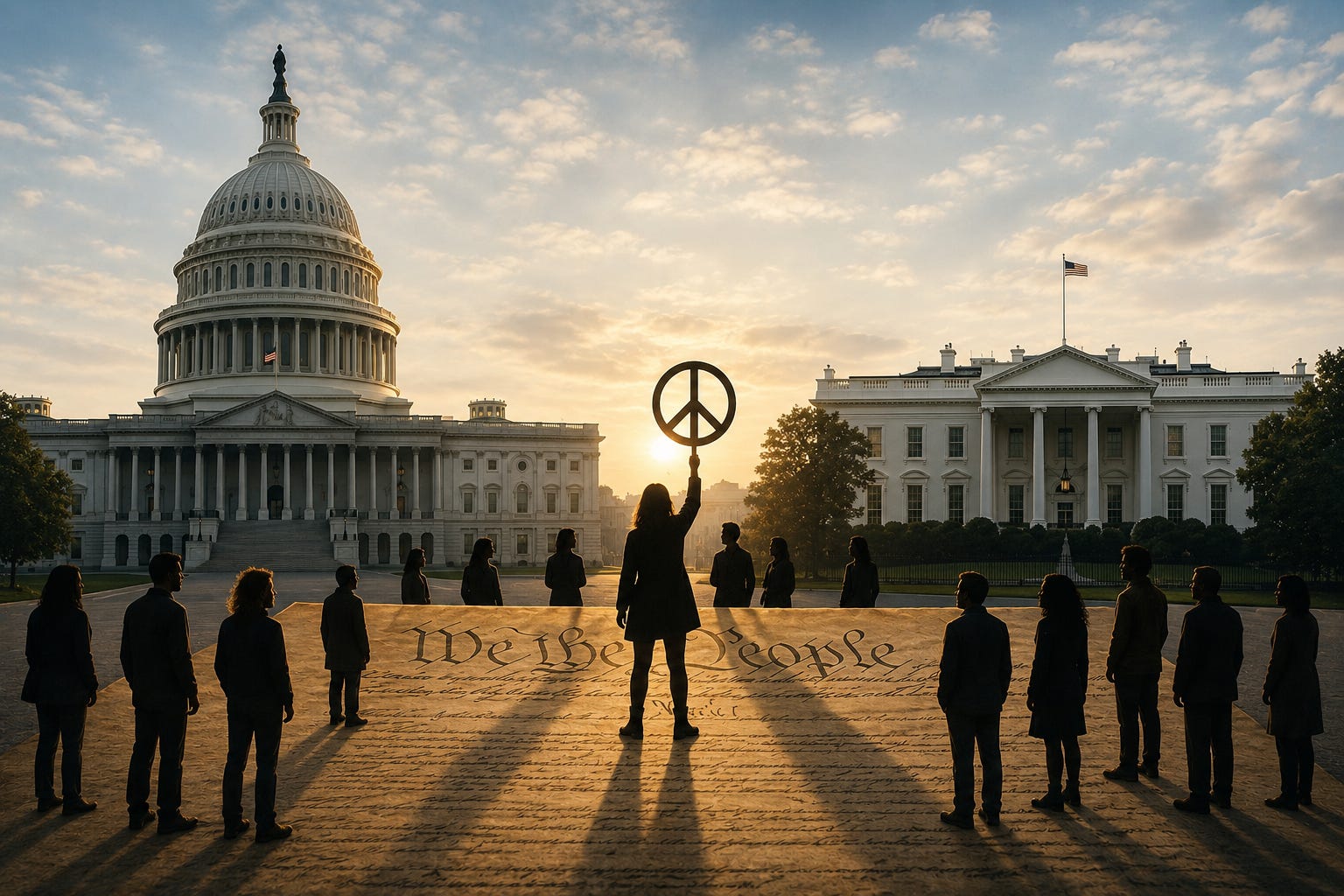
War is not supposed to be one-person government.
That may sound obvious. But every time U.S. presidents use military force without clear approval from Congress, the country has to relearn one of the Constitution’s basic lessons: The power over war is divided on purpose.
I’ve been alive since 1950. In all that time, Congress has never formally declared war, even as the United States has fought in Korea, Vietnam, the Persian Gulf, Afghanistan, Iraq, and elsewhere.
That history is why the constitutional division of power still matters, not as a civics lesson but as a safeguard.
The president is commander in chief. That matters. A president must be able to respond quickly to attacks, threats, and emergencies.
But the Constitution gives Congress the power to declare war, raise and support armies, provide and maintain a navy, regulate the armed forces, and control military funding. Those powers are not decorative. They are part of our government’s system of checks and balances.
That is why congressional action over Iran matters.
On June 3, 2026, the House passed a war powers resolution seeking to require President Trump to withdraw U.S. forces from hostilities with Iran unless Congress authorizes continued military action. The vote was 215-208, with four Republicans joining Democrats.
The measure now depends on Senate action. If it passes both chambers, Trump could veto it, and Congress would need a two-thirds vote in both the House and Senate to override the veto.
If Congress cannot override a veto, the resolution would not force a legal change. But the vote would still matter politically. It would show congressional resistance, put lawmakers on record, and help define the public debate over the legal and democratic support for military action.
That is the larger constitutional question: Who gets to decide when the United States goes to war?
The answer is not simple. But it is not mysterious either. The Constitution divides war powers for a reason, even if modern practice has blurred the lines.
Over time, power has shifted toward presidents. Broad authorizations helped. So did emergency laws, defense spending bills, and congressional hesitation. Formal declarations of war became rare.
But the core principle remains: War power is shared because war is too dangerous to entrust to one person.
Related: For a broader plain-English guide to Congress’s constitutional powers beyond war and military authority, see What Congress Controls That Presidents Don’t.
What the Constitution says about war powers
The Constitution splits war-related power between Congress and the president.
Congress decides whether to formally authorize war.
Article I, Section 8, gives Congress the power “to declare War.” In plain English: Formal war is not supposed to begin on presidential authority alone.
Congress creates, funds, and regulates the military.
Congress may raise and support armies, provide and maintain a navy, make rules for the armed forces, call forth the militia, and organize, arm, and discipline the militia. It also controls spending, which gives it enormous practical power over military action.
The president is commander in chief.
Article II, Section 2, makes the president commander in chief of the Army and Navy, and of state militias when called into federal service. That means the president directs military operations, commands forces, and can respond quickly to attacks or emergencies.
States have very limited war powers.
Article I, Section 10, largely takes war-making away from individual states. States may not keep troops or ships of war in peacetime without Congress’ consent, and they may not engage in war unless actually invaded or facing imminent danger that allows no delay.
The built-in tension
The problem is that modern military action often falls between the categories the Constitution names most clearly.
Without a declaration of war, a president might authorize military action as a limited strike, drone attack, naval deployment, cyber operation, defense of U.S. forces, or support for an ally.
Any one of those actions may be described as short of war—until it expands, continues, or draws the U.S. deeper into conflict.
That built-in tension has grown as modern military action has become faster, sometimes secret, more global, more technological, and less likely to begin with a formal declaration of war.
Congress may object, but too often it’s after the fact.
How later laws changed the balance
Over time, Congress has passed laws that both limit and expand presidential power. Some were meant to restore congressional authority. Others gave presidents broader tools to respond to threats, impose sanctions, aid allies, conduct surveillance, or use force under specific authorizations.
The result is a system that still rests on constitutional checks and balances. But it often operates through statutes, funding bills, emergency declarations, and congressional authorizations rather than formal declarations of war.
The War Powers Resolution
After the Vietnam War, Congress passed the War Powers Resolution of 1973 over President Nixon’s veto. Its purpose was to restore Congress’ role in decisions about sending U.S. forces into hostilities.
The law says the president may introduce U.S. armed forces into hostilities only under three conditions: a declaration of war, specific statutory authorization, or a national emergency arising from an attack on the United States, its territories, possessions, or armed forces.
The law also requires presidents to consult with Congress “in every possible instance,” report to Congress when forces are introduced into hostilities, and generally end the deployment within 60 days, with a possible 30-day withdrawal period, unless Congress authorizes continued action.
The problem is enforcement. Presidents of both parties have often resisted the law’s limits while still filing reports under it or “consistent with” it. That careful wording signals compliance without conceding control.
Authorizations for Use of Military Force
Instead of formal declarations of war, Congress now usually passes Authorizations for Use of Military Force, or AUMFs.
The 2001 AUMF after the Sept. 11 attacks became the legal basis for years of military action against terrorist groups and related forces. The 2002 Iraq AUMF authorized force against Iraq. Both show how broad authorizations can stretch far beyond the moment that produced them.
AUMFs give Congress a role, but they can also give presidents wide room to act if the language is vague or left in place too long.
Military funding laws
Congress funds the armed forces through defense authorization bills, appropriations bills, emergency spending, and other measures.
That gives Congress a powerful tool. It can fund military action, limit it, condition it, or cut off money. But in practice, Congress often hesitates to restrict funding once troops are already deployed. Members do not want to appear to be abandoning service members, even when the real issue is the mission’s legal authorization.
Emergency and sanctions laws
Congress has also passed laws giving presidents broad powers during national emergencies and foreign crises. These laws can allow sanctions, asset freezes, trade restrictions, and other actions short of war.
Those tools can be necessary. But they can also shift power toward the executive branch if Congress does not oversee them carefully.
Military justice and domestic limits
Congress also writes many rules for the military, including military justice. Laws such as the Uniform Code of Military Justice grow out of Congress’ constitutional authority to regulate the armed forces.
At home, laws such as the Posse Comitatus Act generally limit the use of federal troops for domestic law enforcement, while the Insurrection Act allows military involvement in certain domestic crises.
Those laws reflect another constitutional concern: Military power should remain under civilian control and should not become a tool of domestic intimidation.
How the courts have affected war powers
Courts have not given the country one neat war-powers formula. But several Supreme Court cases matter.
In Little v. Barreme, the court held that presidential military orders could not override limits Congress had set by law. That early case stands for a basic principle: Even in military affairs, presidents must follow statutes.
In the Civil War Prize Cases, the court recognized that a president may respond when an actual armed conflict or emergency already exists. That strengthened emergency presidential power, but it did not give presidents unlimited authority to start wars.
In Youngstown Sheet & Tube Co. v. Sawyer, the court rejected President Truman’s seizure of steel mills during the Korean War. Justice Robert Jackson’s famous framework remains central: Presidential power is strongest when Congress authorizes it, uncertain when Congress is silent, and weakest when the president acts against Congress’ expressed will.
In later terrorism and detention cases, including Hamdi v. Rumsfeld and Boumediene v. Bush, the court recognized that Congress and the president may have broad wartime powers, but constitutional rights do not disappear.
What citizens should watch
The Iran debate is not only about Iran.
It is also about whether decisions of war and peace still require public debate, legal authority, and democratic consent. Citizens should pay attention to the questions Congress asks and the questions it avoids:
Has Congress clearly authorized military force?
Has the president reported to Congress as required?
Are U.S. forces already in hostilities?
Is Congress debating the mission before or after the shooting starts?
Are lawmakers willing to use their funding power, or only issue statements?
Are old authorizations being stretched to cover new conflicts?
The Constitution does not make the president powerless in war. But it also does not make the president a king.
War is too grave for autopilot. And it is far too grave for one-person rule.
Related Resources in Plainly, Garbl
Global Governance, International Law, and Accountability
Advocacy organizations focused on international law, sovereignty, and democratic limits on power
Peace, Defense Spending, and Nuclear Arms Control
Advocacy organizations focused on de-escalation, restraint, and arms reduction
PS. I think I know the answer.
This is enlightening, thanks. My question is, since World War 2, have any foreign countries waged war or sent their troops into the US or our territories? (Besides the 9-11 strikes) Or, has it always been our military sent into conflict with other countries?