
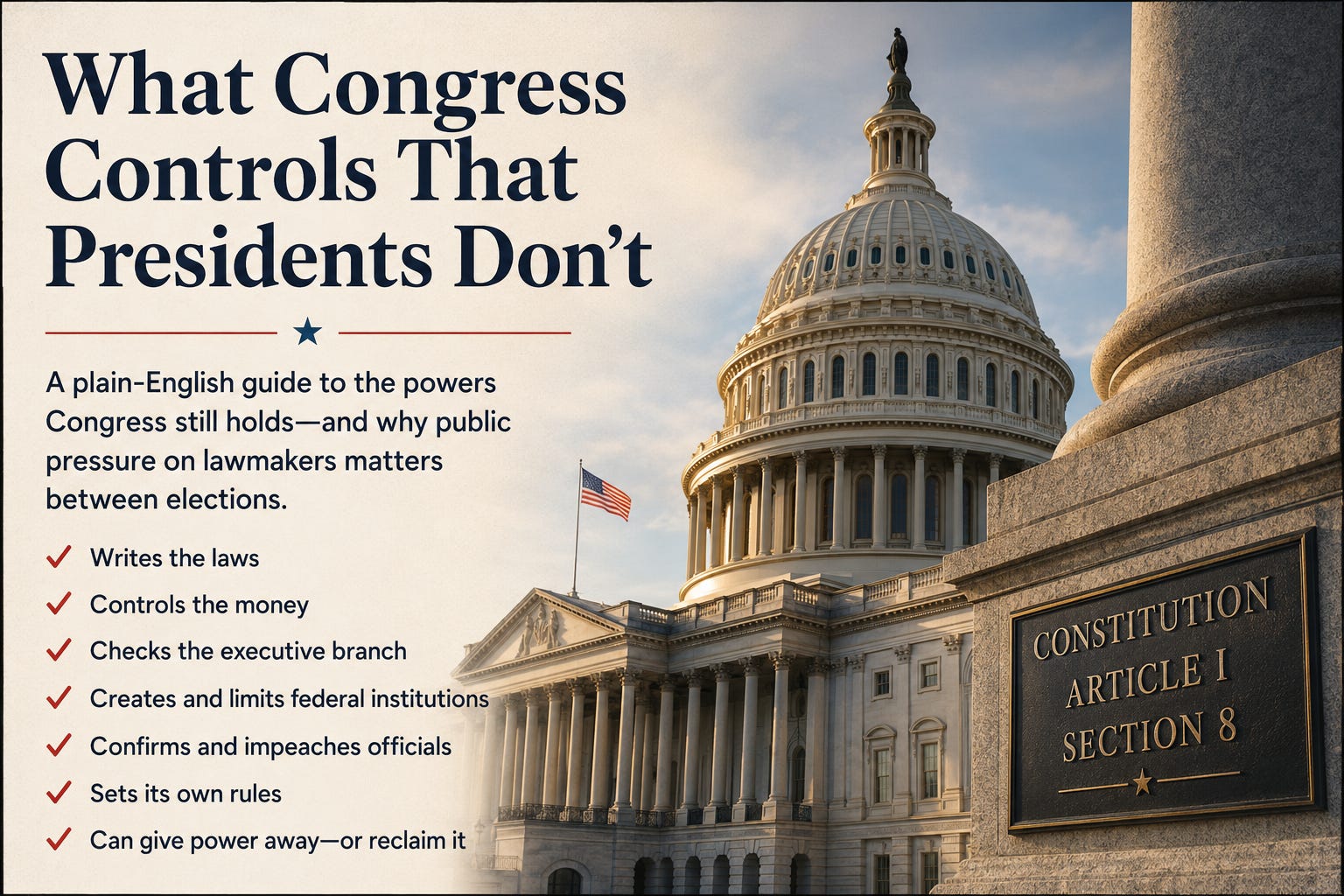
🏛️ What Congress Controls That Presidents Don’t
A plain-English guide to the powers Congress still holds—and why public pressure on lawmakers matters between elections.

Presidents dominate the news.
They hold rallies, sign executive orders, command the military, appoint officials, issue pardons, and speak with the loudest single voice in American government.
But the president is not the whole government.
That should be obvious. Yet President Trump keeps acting as if executive power can override laws, reshape institutions, punish opponents, redirect public money, and bend the federal government to his will.
Too many members of Congress have let him test those limits without the resistance their constitutional duties require—especially members of his own party.
The U.S. Constitution gives Congress enormous powers that are just as central to the country’s direction.
That matters all the time. It matters even more when a president pushes beyond the traditional boundaries of the office. And it matters when Congress lets him.
Congress is not a decorative branch of government. It is not a complaint department. It is not there merely to applaud, object, investigate after the damage is done, or appear on cable news.
Congress has power
Many of Congress’s core powers are listed in Article I, Section 8, of the Constitution. It does more than list technical powers. It gives Congress authority over much of national life. Among other things, Congress may:
Raise revenue, borrow on the nation’s credit, pay debts, and fund public purposes, including the general welfare and national defense.
Regulate commerce among states and with other nations, shaping the rules for trade, business, labor, and markets.
Set immigration and naturalization rules, including the process for immigrants becoming citizens.
Manage national currency by coining money, regulating its value, and punishing counterfeiting.
Create a national postal system by establishing post offices and post roads.
Promote knowledge, scientific discovery, creativity, and invention by protecting copyrights and patents for limited times.
Define certain national and international crimes, including piracy, crimes at sea, and offenses against the law of nations.
Create lower federal courts and shape the federal judiciary, including the size of the Supreme Court, within constitutional limits.
Declare war, fund the military, and regulate the armed forces.
Govern the District of Columbia and certain federal properties, including the power to delegate local authority to D.C.’s elected government—or limit it by law.
Pass laws needed to carry out federal powers through the “necessary and proper” clause.
For a closer look at war powers, see Who Decides When the United States Goes to War?
Congressional powers are not suggestions. A president enforces laws, administers programs, and makes policy choices within legal limits. But the president cannot simply replace Congress’s judgment with executive orders because he dislikes the law Congress passed.
When Congress fails to use those powers, that is also a choice.
Congress writes the laws
The president can propose laws. The president can praise them, attack them, veto them, sign them, ignore political norms around them, or claim credit for them.
But Congress writes the laws to carry out its constitutional powers.
Article I, Section 1, says Congress has “all legislative powers.” That means federal lawmaking belongs to the House and Senate, not to the president alone.
Article I, Section 7, lays out the basic path for bills: Congress passes them, the president signs or vetoes them, and Congress may override a veto with enough votes.
Article II, Section 3, says the president “shall take Care that the Laws be faithfully executed.” Here, execute means carry out. A president may have discretion to direct agencies, enforce requirements, administer programs, and put federal law into practice.
But the president does not have a general power to ignore, repeal, defund, weaken, or discard laws they dislike.
That distinction is basic, but it is often blurred in public debate. When people say, “the president should do something,” sometimes they are really talking about something only Congress can authorize, fund, change, or stop.
That does not mean presidents are powerless. Far from it. But presidential power usually depends on law, funding, delegation, and enforcement authority. Congress helps build that machinery. Congress can also limit it.
Congress controls the money
One of Congress’s strongest powers is the power of the purse.
The Constitution gives Congress the power to tax, borrow, pay debts, spend for the general welfare, and appropriate money. Revenue bills must begin in the House, and no money may be drawn from the Treasury unless Congress has approved it by law. See Article I, Sections 7, 8, and 9.
Federal programs do not run on speeches. Agencies do not operate on campaign slogans. Wars, courts, investigations, public health programs, disaster relief, veterans’ services, national parks, air traffic control, food safety, Social Security administration, and congressional operations all require money.
Congress decides whether to raise money, how to spend it, and what conditions to attach.
That power is not a minor bookkeeping role. It is one of the main ways Congress defines what the federal government can actually do.
A president may request money. A president may pressure lawmakers. A president may threaten a veto. But the Constitution does not give the president a personal checkbook for the federal treasury.
When Congress protects its spending power, it protects representative government.
When Congress allows a president to redirect, freeze, misuse, or ignore money Congress has approved, it weakens one of the most important checks in the constitutional system.
Congress checks the executive branch
Congress also has the power—and the duty—to oversee the executive branch.
That includes hearings, investigations, subpoenas, reports, budget conditions, confirmation questions, and public accountability. Oversight is not supposed to be a partisan hobby, used only when the other party controls the White House. It is part of how Congress makes sure laws are carried out properly.
The Constitution does not put oversight into one neat clause. It flows from Congress’s Article I lawmaking powers and from the Necessary and Proper Clause in Article I, Section 8.
The executive branch is huge. It includes Cabinet departments, law enforcement agencies, military command structures, regulatory offices, grant programs, contractors, inspectors general, and thousands of officials carrying out federal policy.
A president leads the executive branch. But Congress has the authority to ask: What are you doing? Who authorized it? What law allows it? Where did the money come from? Who benefits? Who is harmed? What records prove it?
Those questions are not harassment. They are governance.
Congress creates and limits federal institutions
Congress also creates, names, funds, structures, and limits many federal offices and institutions.
Much of that authority rests on the Necessary and Proper Clause in Article I, Section 8. Congress can create offices, agencies, and institutions by law when they are needed to carry out federal powers. Congress can also define their duties, funding, structure, and limits.
Some are part of the legislative branch, such as the Library of Congress, Congressional Research Service, Congressional Budget Office, Government Accountability Office, Government Publishing Office, and Architect of the Capitol.
Others are federal institutions created by statutes with special structures, duties, boards, names, or missions.
The Kennedy Center is one example. Congress created and named it by law. A president may have influence through appointments and political pressure, but if a name is set by statute, changing it generally requires Congress to change the statute.
The principle applies far beyond one cultural institution. The president may lead the executive branch, but Congress helps define the legal framework within which federal offices and institutions operate.
Congress confirms—or rejects—many top officials
Presidents nominate many senior officials, including Cabinet members, ambassadors, federal judges, and Supreme Court justices. But Article II, Section 2, gives the Senate an advice-and-consent role.
That means the Senate is not supposed to be a rubber stamp. Its role is not merely to ask whether a nominee is loyal to the president. Its job is to ask whether that person is qualified, ethical, lawful, independent enough for the role, and committed to the Constitution.
Consent means the Senate can say yes. It also means the Senate can say no.
Congress also has an advice-and-consent role for treaties negotiated by the president with other countries.
Congress can impeach and remove officials
The impeachment power of Congress is divided among several provisions:
The House has the sole power to impeach under Article I, Section 2.
The Senate has the sole power to try impeachments under Article I, Section 3.
Article II, Section 4, identifies the officials and grounds for removal.
Conviction may also bar that person from holding future federal office.
Impeachment is not a normal policy disagreement. It is a constitutional remedy for serious abuse of public office.
But it exists for a reason: Some misconduct cannot wait for the next election, and some federal officials are not elected at all.
A president cannot pardon an impeachment. A president cannot erase an impeachment conviction. And a president cannot remove members of Congress for using that power.
Congress controls its own rules and officers
Congress also controls much of its own internal machinery.
Article I, Section 5, says each house may determine its own rules, punish its members, and, with a two-thirds vote, expel a member.
Each chamber chooses its leaders. Committees conduct much of the work. Internal officers and staff help the House and Senate function.
That may sound procedural, but procedure can shape power.
For example, the Senate parliamentarian advises on Senate rules and procedure. A president may object to a ruling. A president may pressure senators. A president may complain loudly.
But the president does not run the Senate’s referees.
That matters because Congress cannot remain independent if the executive branch controls the people who interpret congressional rules.
Congress can give power away
There is one more uncomfortable truth.
Congress can weaken itself:
It can pass vague laws that give presidents too much discretion.
It can fail to conduct oversight. It can confirm unqualified loyalists. It can tolerate secrecy.
It can look away from unlawful spending.
It can treat constitutional duties as partisan inconveniences.
It can let emergency powers become routine. It can complain about executive overreach while quietly benefiting from it.
When that happens, presidential power grows not only because presidents seize it but also because Congress allows it.
That is dangerous, no matter which party controls the White House.
A Congress that surrenders power to a president from its own party may later discover that the power is still gone when the other party wins.
Why this matters to citizens
That is why civic pressure cannot focus only on the White House.
Presidents matter. Elections matter. Executive orders matter. Courts matter.
But members of Congress matter too.
They can write laws. Fund programs. Block spending. Demand records. Hold hearings. Reject nominees. Expose misconduct. Protect agencies. Defend courts. Declare war or refuse to authorize it. Impeach officials. And set limits the president must obey.
Or they can fail to do those things.
When Congress has power but does not use it, voters should know where the responsibility lies.
The Constitution does not make Congress helpless.
Politics sometimes does. And politics can change.
Related Resources at Plainly, Garbl
Contact Information: Washington’s U.S. Senators and Representatives
Phone calls are recommended. Or send an email using the contact form on their website.How to Track What Congress Actually Does
Follow bills, votes, hearings, committees, and other congressional action.Suggested Text for Writing Email Messages to Elected Officials
Use or adapt sample language for emails. The same points can also work as a script for phone calls.