

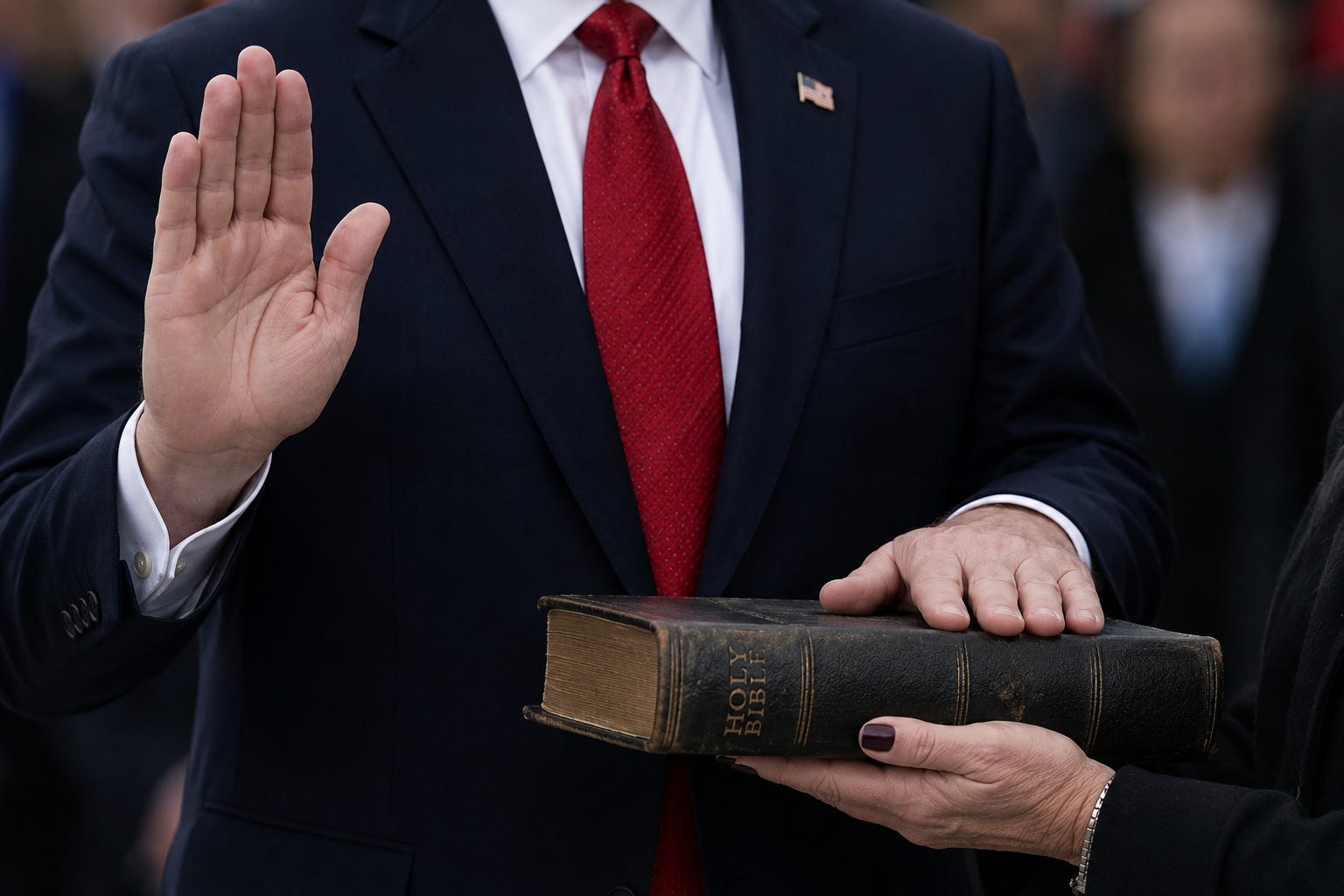
The U.S. president is not a king. Our country’s founders revolted against a foreign king because they believed citizens should have the right and power to govern themselves.
No single person is wise or compassionate enough to rule a people without restraint. History has proved that too often.
That restraint is built into the U.S. Constitution with its separation of powers among the three federal branches, the states, and citizens themselves. The Constitution gives each branch powers, duties, and limits.
That is not a weakness in the system. It is one of the system’s main safeguards. Those limits matter regardless of party, ideology, or personality.
Of course, the president is the head of the executive branch. That means the president has real authority over federal departments, agencies, officers, and national priorities.
But the Constitution does not merely give the president power. It also gives the president responsibilities. Presidents must agree to those limits before taking office, as stated in Article II, Section 1.
The president must swear or affirm in the oath of office to “faithfully execute the Office of President” and to “preserve, protect and defend the Constitution.” Article II, Section 3, also requires the president to “take Care that the Laws be faithfully executed.”
Those words matter.
The Take Care Clause is especially important. It means the president is responsible for seeing that federal laws are carried out. It does not mean the president may rewrite those laws, ignore them, or enforce only the parts the president personally favors.
The president leads the executive branch. The president does not own the law.
In my view, a president who refuses to obey valid laws is not faithfully executing the office. A president cannot take care that the laws are faithfully executed while claiming a personal right to ignore them.
Of course, that requirement should apply to every president, including Donald Trump.
Constitutional powers of the president
Article II, Section 2 and Section 3, give the president major powers. Some belong mainly to the president. Others require action by Congress or the Senate.
The president can:
Serve as commander in chief of the armed forces.
Require written opinions from heads of executive departments.
Grant reprieves and pardons for federal offenses, except in cases of impeachment.
Make treaties, with approval from two-thirds of senators present.
Nominate ambassadors, judges, Cabinet officers, and other federal officials, usually with Senate confirmation.
Fill some vacancies temporarily during Senate recesses.
Receive ambassadors and other public ministers and conduct diplomacy.
Recommend legislation and policy measures to Congress.
Sign or veto bills passed by Congress.
Convene Congress in extraordinary circumstances.
Commission officers of the United States.
Those powers are significant. Presidents shape national policy, direct federal agencies, influence foreign affairs, and make decisions that affect millions of people.
But much presidential power depends on laws passed by Congress, funding approved by Congress, Senate confirmation of officers, court review of decisions, and the actions of federal agencies carrying out lawful authority.
The president leads the executive branch
The executive branch is large because the federal government is large. Cabinet departments and federal agencies administer laws on health, labor, education, transportation, agriculture, national security, civil rights, immigration, environmental protection, consumer safety, taxation, veterans’ services, and much more.
Presidents set priorities for that branch. They appoint leaders. They direct agencies. They issue policies. They decide how to use lawful discretion.
But agencies do not exist simply because a president wants them. Congress creates federal departments and agencies, defines many of their powers, funds them, oversees them, and can revise the laws they administer.
The president may steer the executive ship. Congress built much of the ship, controls much of the fuel, and can change the rules of navigation.
Executive orders and other presidential actions
Executive orders are one tool presidents use to direct the executive branch.
An executive order is a written presidential directive, usually aimed at federal agencies and officials. It may guide how agencies carry out existing law, organize federal operations, or set priorities within the president’s legal authority.
Presidents also use memoranda, proclamations, national security directives, signing statements, policy guidance, and other written actions. Federal agencies may then issue rules, guidance, enforcement priorities, or program changes.
These actions can matter a great deal. They can affect immigration enforcement, civil rights enforcement, federal employees, contractors, public lands, national security, emergency response, and agency priorities.
But they are not all the same thing.
A presidential speech is not a law, and a news release is not a statute. An executive order is not a constitutional amendment, and an agency rule is different from an act of Congress.
A presidential action does not become valid just because it is written on White House letterhead. It must rest on legal authority.
What presidents cannot do alone
Presidents cannot lawfully do everything they announce, promise, or demand.
A president cannot:
Amend the Constitution by executive order.
Repeal or rewrite laws passed by Congress.
Spend money Congress has not authorized or appropriated.
Give agencies powers Congress has not provided.
Override valid court orders.
Command federal officials to violate the Constitution.
Eliminate rights protected by the Constitution.
Turn personal preference into federal law.
Ignore the Constitution, even in the name of urgency.
Replace Congress as the lawmaking branch.
Treat public office as personal power.
Congress can respond through legislation, appropriations, oversight, confirmation, and impeachment. See What Congress Controls That Presidents Don’t.
And later presidents can revise or revoke executive actions, especially when those actions are based on presidential discretion rather than a statute.
The announcement is not the end of the story.
Where the courts matter
Courts also limit presidential power. When executive actions are challenged, courts may decide whether the president or an agency acted within constitutional and statutory limits. Courts can block unlawful executive actions, interpret federal laws, enforce constitutional rights, and require agencies to follow proper procedures.
Courts do not review every presidential decision. Some disputes are political, discretionary, or difficult for courts to resolve. But when the law gives courts a role, they can be a major check on executive power.
The courts do not always get it right, however. The political philosophies of individual court members can influence their interpretation of the Constitution, its history, other court decisions, laws enacted by Congress, and actions of the executive branch.
In my view, the Supreme Court’s 2024 presidential-immunity decision was wrong because it weakened a basic principle of constitutional government: No president should be above the law. The ruling remains part of constitutional law unless changed by future court decisions, legislation where possible, or constitutional amendment.
Citizens, Congress, state governments, advocates, lawyers, scholars, and the news media all have roles in reviewing court decisions, challenging harmful rulings, and seeking lawful ways to change them.
What citizens can do
When a president or federal agency acts, citizens do not have to stand aside.
You can:
Read the actual executive order, memorandum, proclamation, rule, or agency notice.
Look for the legal authority the action claims.
Contact your members of Congress.
Submit public comments on proposed federal rules.
Follow court challenges from reliable legal and news sources.
Support watchdog, civil rights, public-interest, and accountability organizations.
Vote in federal, state, and local elections.
Keep asking whether public officials are following the law, not just whether they are getting their way.
Executive power is real. So are its limits.
The job of citizens is to remember both.
Related Resources at Plainly, Garbl
How to Contact Federal Officials—and Be Heard
U.S. Cabinet-level Departments and the Executive Office of the President
What Congress Controls That Presidents Don’t
The U.S. Constitution and the Judicial Branch