

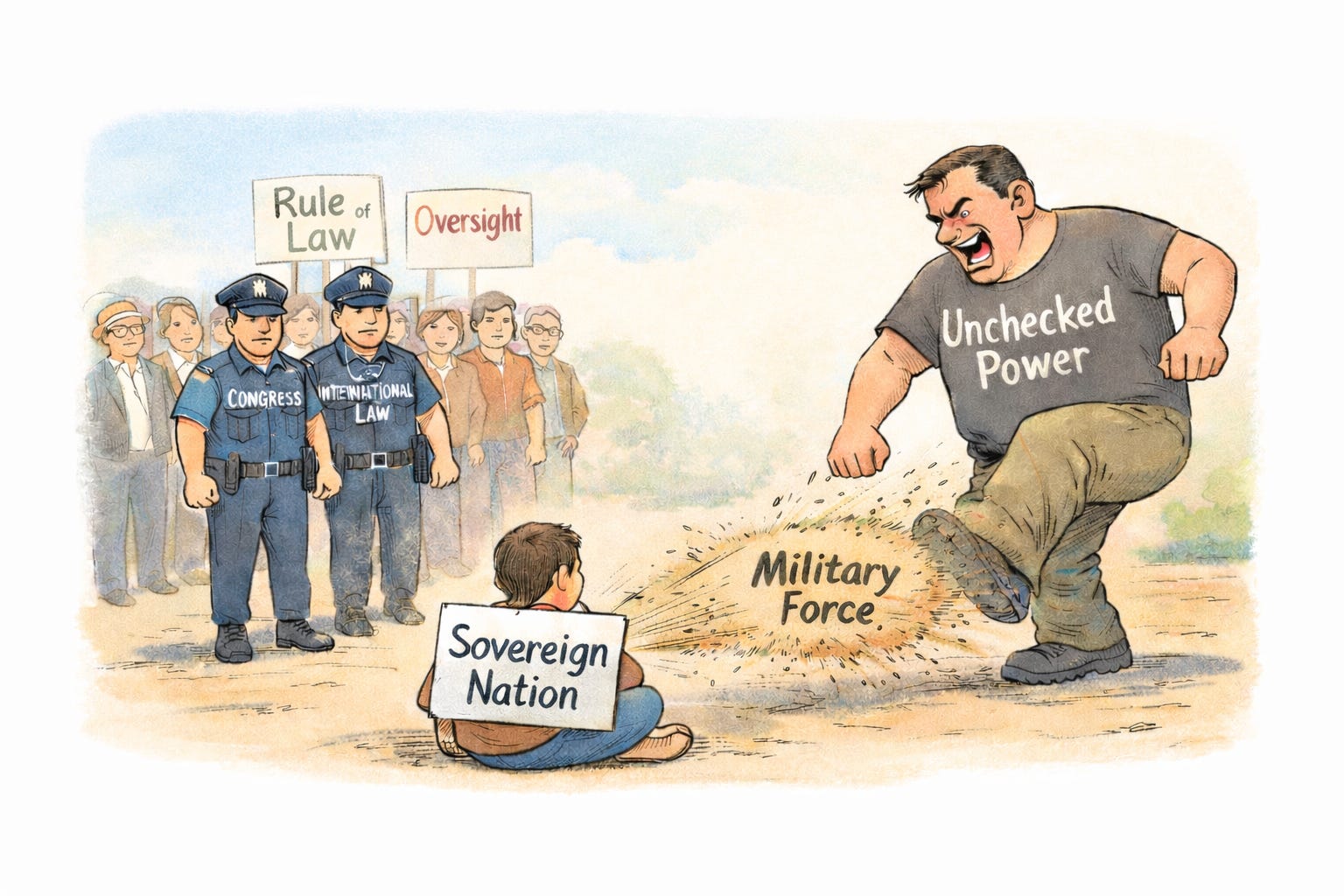
The United States has no authority or right to be attacking Venezuela by land, sea, or air.
I support Venezuela in doing whatever it can to defend itself, consistent with international law. I realize it’s a small country with a much smaller military facing a powerful nation. But I don’t want it to roll over and accept what the U.S. bully is doing to it.
In recent statements, Trump has claimed that U.S. forces struck or disabled a coastal loading site connected to drug trafficking inside Venezuela. At the same time, the White House, Pentagon, and CIA have declined to publicly confirm details or provide evidence.
Major news outlets have reported the claim but also note that key facts are still unverified. Congress, the news media, and the public must demand clear legal reasons, evidence, and oversight.
International law: the simple rule, and the narrow exceptions.
I also want the United Nations and other international bodies to condemn the U.S. and Donald Trump for breaking international law by attacking a sovereign country.
The U.N. Charter prohibits member states from using military force against another country’s territory or political independence. There are only two narrow exceptions:
Self-defense after an armed attack
Explicit authorization from the U.N. Security Council
Drug trafficking is a serious crime, but by itself it does not qualify as either exception.
There is no public evidence that Venezuela launched an armed attack on the U.S., and the U.N. has not authorized military action. “We don’t like your government” is not a legal exception. Neither is “we want your oil.”
U.S. law: why Congress matters even with a commander in chief
I know the president has the power of commander in chief and other constitutional powers and legislative authority for international relations. But I believe his actions toward Venezuela are an overreach.
The Constitution does not give the president a blank check for a new conflict. It divides war powers on purpose. While the president is the commander in chief (Article II, Section 2), Congress alone has the authority “to declare War” and authorize new hostilities (Article I, Section 8).
The War Powers Resolution requires the president to let Congress know within 48 hours of introducing U.S. forces into hostilities and limits such actions unless Congress explicitly approves them.
If U.S. forces are operating within or against Venezuela, Congress has not yet held a full public debate or vote authorizing that use of force.
War powers precedents
U.S. history offers repeated warnings about unchecked war powers. A few widely recognized examples illustrate the pattern:
Vietnam War (1960s–1973)—Presidents Lyndon B. Johnson and Richard Nixon:
Years of escalating military involvement without a formal declaration of war led Congress to pass the War Powers Resolution in 1973. It explicitly reclaimed the constitutional authority of Congress.Cambodia bombings (1970–71)—President Richard Nixon:
The administration secretly bombed Cambodia while denying it publicly. The actions were later exposed through the Pentagon Papers, underscoring the dangers of executive secrecy and the critical role of a free press.Kosovo air war (1999)—President Bill Clinton:
U.S. forces joined NATO airstrikes in the former Yugoslavia without explicit congressional authorization. When members of Congress sued, the courts declined to intervene, reinforcing that war-powers disputes are mainly political, not judicial.Iraq War authorization (2002)—President George W. Bush:
Congress authorized military action based on intelligence claims later shown to be flawed. That revelation led many lawmakers to acknowledge that oversight and evidence-testing failed before the war began. Many citizens protested loudly.Libya intervention (2011)—President Barack Obama:
The administration argued that U.S. military action did not constitute “hostilities” under the War Powers Resolution, a claim widely disputed in Congress, highlighting how easily executive interpretations can stretch legal limits.
The pattern is consistent: Courts rarely step in. Presidents test boundaries. And meaningful limits depend on Congress asserting its authority before conflicts escalate.
The fact that past presidents have pushed or ignored congressional war powers does not make it lawful or acceptable when this president does the same.
Precedents and court reality: why lawsuits are complicated (but politics isn’t)
Of course, I want my U.S. Sens. Patty Murray and Maria Cantwell and U.S. Rep. Emily Randall to also condemn the Trump administration. And I want my state Attorney General Nick Brown to join with others to sue the administration for what it’s doing.
Courts have often been reluctant to referee war-powers disputes between Congress and the president, citing procedural limits. But lawsuits by state attorneys general can still be powerful. Especially when paired with congressional oversight, they can force disclosures, challenge unlawful spending, and increase political and legal pressure.
Comparison: ‘Venezuela vs. U.S.’ and ‘Ukraine vs. Russia’
The legal and moral principle is the same whether the aggressor is Russia or the U.S.: Powerful nations do not get to use force against sovereign countries without lawful justification. Different excuses do not change the underlying rule.
If we reject Russia’s invasion of Ukraine because it violates sovereignty and international law, we must apply the same standard to ourselves.
Venezuela has the same sovereignty protections as any U.N. member and a right to self-defense consistent with the U.N. Charter. The priority should be preventing escalation and protecting civilians.
Summary of talking points
If the U.S. is striking inside Venezuela, the administration must show a lawful basis under both U.S. law and the U.N. Charter.
Drug trafficking is a crime. It’s not a standing permission slip to use military force on another country’s territory.
Congress is not a spectator. War Powers limitations exist precisely to prevent unilateral, open-ended conflicts.
Courts often won’t settle this. That makes congressional votes, oversight, and funding limits even more important.
If the facts are classified, the legal logic can’t be. A democracy can’t run a mystery war.
What to demand from Congress
Ask our senators and representatives to:
Demand a formal War Powers vote on any U.S. hostilities within or against Venezuela.
Require the administration to publicly show the legal authority it claims for these actions.
Hold oversight hearings to examine evidence, targeting decisions, and risks of escalation.
Block funding for military action against Venezuela unless Congress explicitly authorizes it.
What to demand internationally
Call for U.N. debate and formal scrutiny of the legality of cross-border force claims. Enforcement is hard; veto politics is real. But it’s still worth pushing for the record and pressure.
Encourage regional bodies, such as the Organization of American States, to press for de-escalation.
Resources for taking action
🏛️ Contact Information: Washington’s U.S. Senators & Representatives
🧰 Suggested Text for Writing Email Messages to Elected Officials
🧰 Online Guides for Writing Letters to the Editor
🧰 Tools for Action: Events, Rallies & Organizing Platforms
🌍 International & Regional Bodies
🟪 Peace, Defense Spending & Nuclear Arms Control—A ranked guide to advocacy groups fighting nuclear weapons, bloated budgets, and endless wars.
If this commentary resonates with you, please share it with friends.
Get new posts from Plainly, Garbl delivered to your inbox.