
🔤 Multilingual Writing: Know Your Readers
Multilingual readers do not all have the same needs.
Introduction | Why This Matters | Plain Language | Readers | Sentences | Words | Consistent Terms | Design | Translation Prep | Machine Translation | Review | Checklist
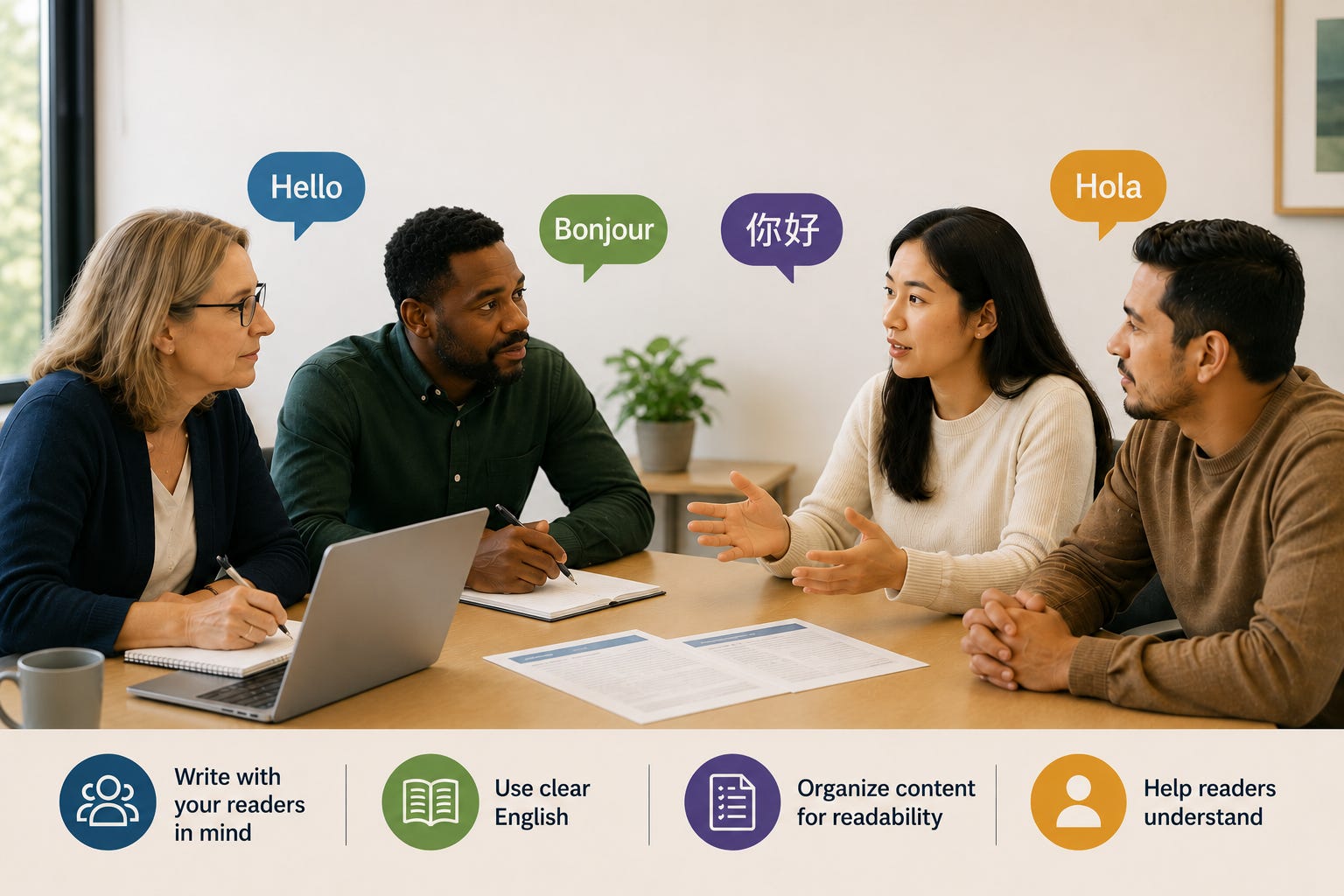
Before you write, think about who will read, translate, interpret, or use the information. Some readers may be new to English. Some may use English every day. Some may need translated or interpreted information. Consider what readers already know, what they need to do, and what may make the information difficult to understand or use.
Before you write, think about who will read, translate, interpret, or use the information. Consider what readers already know, what they need to do, and what may make the information difficult to understand or use.
Readers are not one group
Do not assume everyone who uses English as an additional language has the same needs. Readers may differ in many ways:
• The language or languages they use best
• How long they have used English
• How well they read, speak, write, or understand English
• How much education they have had, in English or another language
• How much they know about the subject
• How familiar they are with U.S. systems, customs, laws, forms, or public services
• Why they need the information
Some readers may be immigrants building permanent lives in the United States. Some may be refugees or asylum seekers. Some may be visitors, students, workers, parents, business owners, patients, tenants, riders, voters, or community members. Some may live outside the U.S. and use English for work, school, travel, science, technology, government, culture, or international communication.
English skills can vary
Some readers may know only a little English. Some may be learning English for daily life, work, school, public services, or community participation. Others may use English often but still struggle with written forms, technical terms, or unfamiliar systems.
A person may read English well but speak it less comfortably. Another may speak English fluently but read it less confidently.
Readers may rely on translated documents, interpreters, bilingual staff, community organizations, family members, machine translation, or a combination of these. Do not assume the same kind of assistance will work for everyone.
Writing for multilingual readers does not mean writing awkward or oversimplified English. When you write or revise, make the text clearer without making it sound unnatural. If a change does not improve the text for all readers, try another way.
Avoid assumptions
Avoid making assumptions based on a person’s language, accent, name, country of origin, race, ethnicity, citizenship, education, job, or appearance.
A person may speak several languages. A person may speak only one language other than English. A person may be highly educated in another language but still need help with English-language forms or instructions. A person may be new to English but expert in the subject you are writing about.
You do not need to know everything about every reader. But you should not assume that English skill, education, subject knowledge, and life experience are the same thing.
For advice on choosing words that respect people and make meaning clear, see Garbl’s Inclusive Language Guide.
Know what readers need to do
Think about the task. What do readers need to do with the information?
• Apply for a service?
• Follow safety instructions?
• Use a bus route?
• Fill out a form?
• Attend a meeting?
• Understand a school notice?
• Make a health decision?
• Respond to a legal notice?
• Join a program?
• Vote, pay a bill, or ask for help?
Know what readers already understand
Also think about what readers already know. Do they understand the system, agency, form, program, deadline, location, or process? Do they know what will happen next? Do they know who to contact?
Make the stakes clear if the information affects people’s rights, money, safety, health, school, job, housing, immigration status, or family. Readers should not have to guess what matters most.
Ask people who know the audience
When possible, learn from people who know the readers. Talk with translators, interpreters, bilingual staff, teachers, outreach workers, community groups, customer service staff, and people who have used the information before.
Ask simple questions:
• Where do readers get confused?
• What words do readers use?
• What questions do readers ask?
• What information is missing?
• What part of the process is hardest to understand?
Respect is practical
Good writing starts with respect. Readers should not have to decode the writer’s assumptions before they can use the information.
Writers cannot know everything about every reader. But they can ask clear questions, avoid easy assumptions, and write so more people can understand and use what they need.
Introduction | Why This Matters | Plain Language | Readers | Sentences | Words | Consistent Terms | Design | Translation Prep | Machine Translation | Review | Checklist