
Democrat or Democratic Socialist?
How to use political labels clearly, accurately, and respectfully

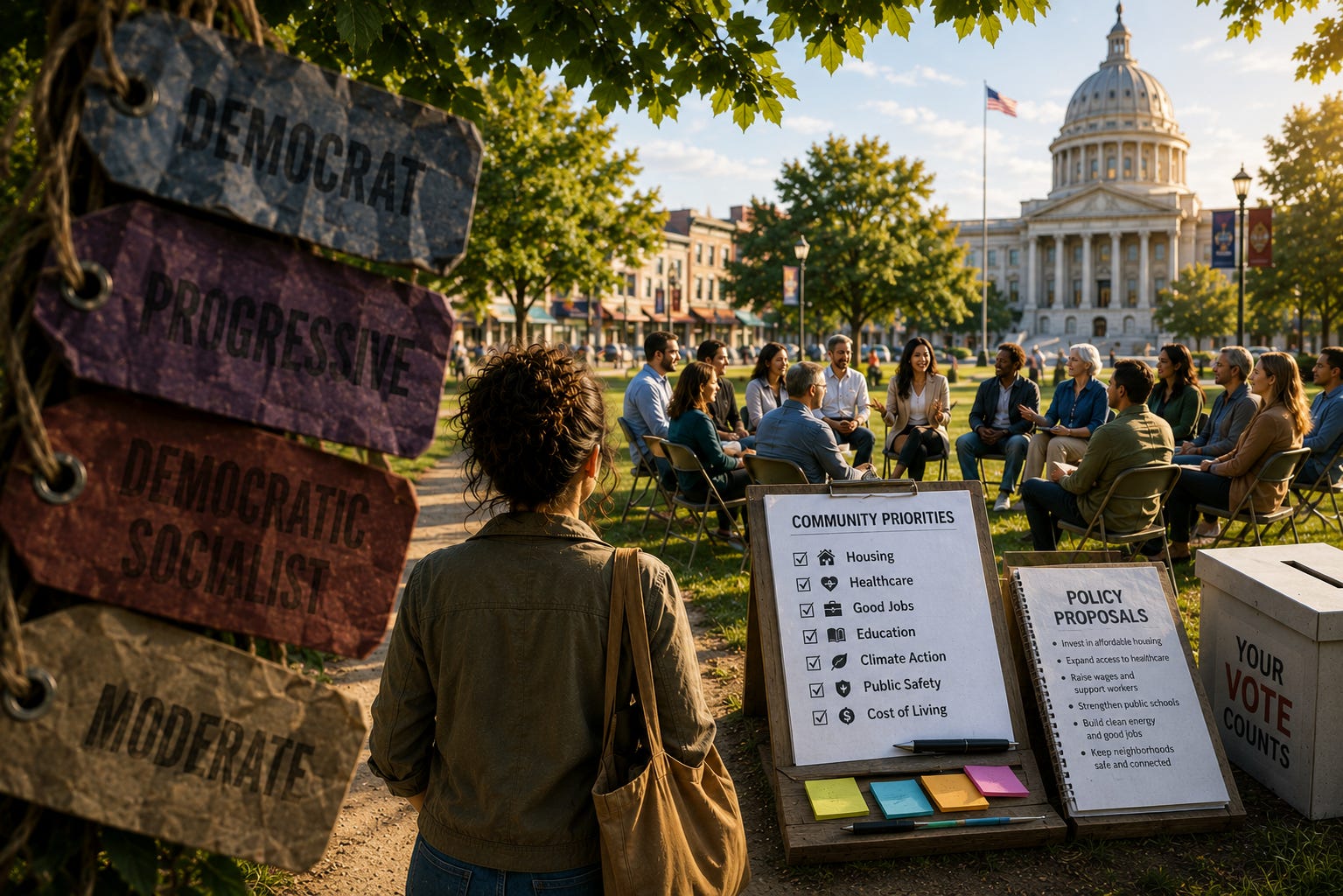
Political labels can help us understand candidates and movements. They can also oversimplify beliefs, distort differences, and replace serious discussion with praise, ridicule, or fear.
That is especially true of terms such as Democrat, progressive, liberal, socialist, and democratic socialist. Politicians and commentators do not always use them consistently. Opponents sometimes use them inaccurately on purpose.
Clarity, accuracy, and respect do not require agreement. They require us to describe political beliefs fairly and then examine the policies behind the labels.
My interest in this subject begins with language. As a writer and editor, I want political labels to help people understand ideas and proposals, not replace them with assumptions, stereotypes, or fear
The labels describe different things
A Democrat is generally a member or supporter of the Democratic Party.
A democratic socialist identifies with a political philosophy or movement that seeks to extend democratic power more deeply into economic life.
A politician can be both.
The Democratic Party is a broad electoral coalition that includes democratic socialists, progressives, liberals, moderates, and people who hold relatively conservative positions on some issues.
The Democratic Socialists of America is a political organization, not one of the nation’s two major parties. Its members often support candidates running as Democrats.
Comparing Democrats with democratic socialists is not like comparing Democrats with Republicans. One term names a political party. The other names a political philosophy embraced by some people within that party.
What do Democrats generally support?
No description fits every Democrat. In general, though, Democrats support using government to protect civil and voting rights, defend personal freedoms, regulate businesses, provide public services, protect the environment, and reduce economic and social inequality.
Most Democrats accept a mixed economy in which businesses remain largely privately owned but operate under public laws, taxes, labor standards, and consumer protections. They generally support broader access to healthcare, education, housing, and economic assistance, as well as public action to address climate change.
Progressive Democrats generally support stronger labor protections, broader public programs, higher taxes on wealth, and more aggressive limits on corporate power. Moderate and mainstream Democrats are more likely to emphasize regulated private markets, public-private partnerships, gradual change, fiscal constraints, and bipartisan compromise.
Democrats may disagree sharply about particular policies while remaining broadly aligned on rights, public investment, social protections, and democratic government. Their disagreements usually concern the size, pace, and methods of change.
What do democratic socialists generally support?
Democratic socialists often support the same immediate proposals as progressive Democrats, including stronger unions, universal healthcare, affordable housing, progressive taxation, and major public investment.
But democratic socialism generally goes beyond making capitalism fairer.
Democratic socialists argue that political democracy remains incomplete when wealthy owners, investors, and corporations primarily control major economic decisions. They seek to give workers and the public more influence over workplaces, essential services, investment, and production.
That can include stronger unions and workplace democracy, worker cooperatives or employee ownership, public control of some essential services, and greater democratic influence over economic development and investment.
The distinction is not simply that democratic socialists support larger public programs. It also concerns who owns economic resources, who makes major decisions, and how power is distributed between workers, the public, corporations, and investors.
Democratic socialists do not all agree about how much of the economy should be publicly, cooperatively, or privately owned. The label describes a general direction, not a complete governing plan.
Where do the policies overlap?
Progressive Democrats and democratic socialists may support the same legislation on:
Wages and unions
Healthcare and prescription drugs
Housing and childcare
Taxes and corporate power
Climate and public transportation
They may vote for the same proposal while understanding its purpose differently.
A progressive Democrat may see a stronger public program as a way to regulate capitalism, correct market failures, and distribute opportunity more fairly.
A democratic socialist may also see it as a step toward shifting power from corporations and investors to workers and the public.
The immediate policy may be the same even when the longer-term philosophies differ.
Where does the deeper difference begin?
The central difference concerns economic power.
Most Democrats want democratic government to regulate markets, provide public services, protect workers and consumers, and distribute economic benefits more fairly.
Democratic socialists also question whether private ownership gives a relatively small group too much control over workplaces, investment, essential services, and public policy.
Put simply:
Most Democrats seek to regulate and rebalance capitalism. Democratic socialists seek to extend democratic power more directly into the economy itself.
That difference becomes important when deciding whether services such as healthcare, energy, housing, or transportation should be provided mainly by private businesses, public agencies, nonprofit organizations, cooperatives, or a combination.
A mainstream Democrat may view responsible businesses as necessary partners that need effective regulation. A democratic socialist is more likely to view concentrated corporate power as a structural problem that regulation alone cannot solve.
What do the labels tell voters?
Political labels provide clues, not conclusions.
The label democratic socialist may suggest that a candidate strongly supports workers, universal public programs, progressive taxation, and limits on corporate power.
The label Democrat usually signals broad alignment with the party on civil rights, personal freedoms, public investment, and social protections.
A label may indicate a candidate’s priorities and general view of government. It does not provide a complete platform or establish the candidate’s judgment, competence, or ability to turn goals into workable policy.
Respecting a person’s chosen label does not require supporting that person. It means using the label accurately rather than substituting a caricature.
Calling every Democrat a socialist is inaccurate. Treating every public service as socialism makes the word nearly meaningless. Assuming every democratic socialist wants government to control every business is also inaccurate.
Look beyond the label
Ask:
What does the candidate actually propose?
Who would benefit, and who would pay?
Would the policy rely on public agencies, private businesses, nonprofits, or cooperatives?
Is there evidence that it could work?
Can the candidate turn the goal into workable policy?
Does the candidate respect elections, rights, lawful government, independent journalism, and political opposition?
Ideology still matters. It shapes candidates’ priorities, diagnoses of public problems, and preferred solutions.
But a political label should begin our examination, not end it.
Clarity supports democratic choice
Using political terms clearly, accurately, and respectfully helps voters distinguish a party label from a political philosophy, current proposals from long-term goals, and real disagreements from manufactured fear.
The most useful question is not simply whether a candidate is a Democrat, progressive, liberal, moderate, or democratic socialist.
It is what that candidate believes, proposes, and is prepared to do with public power.
Resources from Plainly, Garbl
Supporting Liberal, Progressive, Democratic Officeholders, and Candidates
A guide to advocacy and training groups that build Democratic power and promote liberal and progressive leadership.Contact Information: Washington’s U.S. Senators and Representatives
Their websites also include information on issues, services, office locations, recent votes, and committee assignmentsContacting Washington State Officials and Key Departments
This guide helps you contact elected officials, track legislation, and advocate for what matters