
📰 Before You Believe, Buy, Donate, or Share
A media-literacy guide to propaganda, advertising, fundraising, and scams

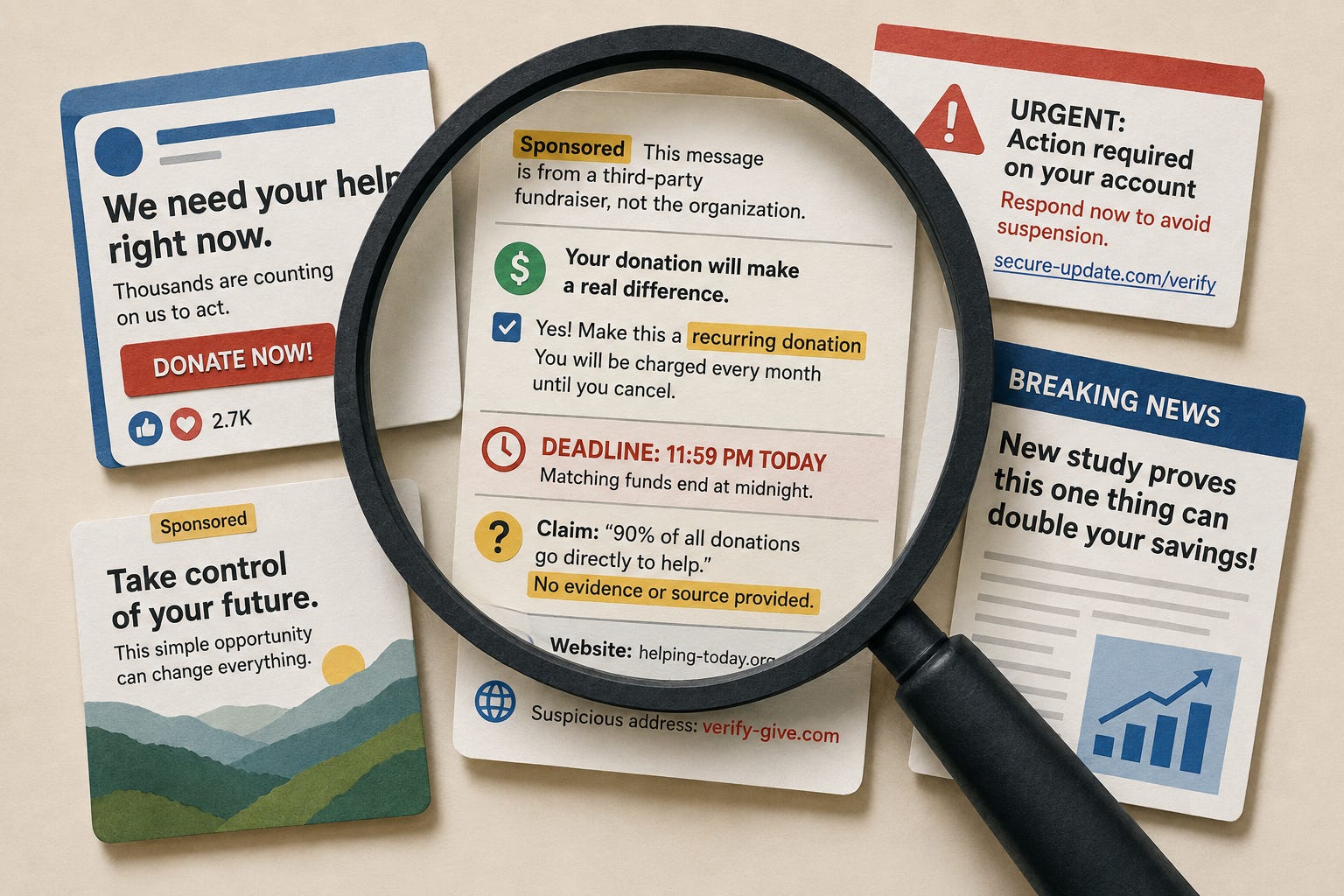
Messages compete constantly for our attention, trust, money, votes, personal information, and help spreading their claims.
Some provide useful information or make honest arguments. Others exaggerate, conceal important facts, imitate trusted sources, or push people to act before they have time to think.
A deceptive message may look like a news story, political appeal, advertisement, charity request, social media post, fundraising email, text from a familiar organization, or warning from a government agency. Artificial intelligence makes it easier to produce convincing images, voices, websites, and messages, but many of the underlying tactics are not new.
Learning to recognize those tactics does not require distrusting everything. It requires slowing down when a message tries to prevent careful thought.
In this guide: Understand the message | Evaluate particular appeals | Pause, verify, and respond | Related Plainly, Garbl resources | Key government resources
Understand the message
Persuasion is not always deception
Propaganda, advertising, political advocacy, fundraising, and scams are not the same.
Advertising tries to sell something. Political advocacy tries to influence public opinion or action. Fundraising asks people to support a candidate, organization, campaign, charity, or cause. Propaganda promotes a viewpoint, often by selecting and shaping information to influence emotions and beliefs.
Any of them can be accurate or misleading. They become deceptive when they hide who is communicating, impersonate a trusted source, make false or unsupported claims, conceal important conditions, or misrepresent what will happen after someone responds.
A scam goes further. It uses deception to get money, personal information, account access, property, or something else of value.
The categories can overlap. A fraudulent donation request may use propaganda, marketing techniques, political language, and a fake organizational identity at the same time.
The important question is not simply what kind of message it is.
Ask:
What is this message trying to make me believe, feel, give, buy, reveal, or do?
Notice when a message is pushing your emotions
Emotion is part of ordinary human communication. A message is not false merely because it makes people angry, afraid, hopeful, sympathetic, or enthusiastic.
But strong emotion can make verification feel unnecessary or even disloyal.
Be especially cautious when a message tries to provoke:
Fear about an immediate threat
Anger toward a person or group
Guilt about failing to help
Excitement about an unusual opportunity
Affection or loyalty toward someone asking for help
Outrage that encourages immediate sharing
Panic about an account, debt, arrest, fine, family emergency, or expiring benefit
Certainty that only foolish, corrupt, or uncaring people would question the claim
Ask yourself:
What am I feeling?
What does that feeling make me want to do?
Has the message given me enough reliable information to justify that action?
Do not confuse an emotional response with evidence.
Be suspicious of manufactured urgency
Urgency is sometimes legitimate. Elections close. Emergencies happen. Matching grants end. Event registration fills. People facing danger may need help immediately.
But urgency is also one of the most common ways to prevent scrutiny.
Warning signs include:
Act now.
Do not tell anyone.
Stay on the line.
Respond before midnight.
Your account will be closed.
You will be arrested or fined.
Only a few opportunities remain.
This is your last chance.
Send this to everyone immediately.
Do not let the other side find out.
We need your donation in the next few minutes.
A deadline stated in a message may be real, exaggerated, repeatedly renewed, or entirely invented.
Pause before responding. A legitimate organization should be able to withstand the time needed for you to verify its identity and claims.
Verify outside the message
Do not rely on the contact information, links, buttons, or instructions in a message you are trying to verify.
Instead:
Type the organization’s known website address yourself.
Use an official app you already have.
Call a number from a bank statement, membership card, government website, or other reliable source.
Contact the person through a number or account you have used before.
Search for the organization independently.
Ask someone you trust to review the request.
Scammers can imitate caller identification, email addresses, logos, invoices, websites, social media accounts, government notices, and messages from people you know. A familiar appearance does not establish a familiar source.
The Federal Trade Commission advises people who receive unexpected messages not to use the links or telephone numbers provided in them. Contact the organization through a website, email address, or telephone number you already know is genuine.
Check who is speaking
Before believing or acting on a message, look for a clear and verifiable source.
Ask:
Who created or paid for this message?
Is the person or organization clearly identified?
Does the website address match the organization’s official domain?
Is the social media account genuine?
Is the message from the organization itself, a contractor, a fundraising company, an affiliate, or an unrelated group with a similar name?
Does the message explain where the money or information will go?
Can its claims be confirmed elsewhere?
Be cautious when a message borrows authority from:
A government agency
A bank or payment service
A news organization
A political candidate
A charity
A police department or court
A well-known business
A religious or community leader
A family member, friend, colleague, or romantic interest
Impersonators depend on the reputation of someone else. They want the borrowed identity to do the persuading for them.
Examine the evidence, not just the claim
A confident statement is not necessarily a documented statement.
Look for:
Links to original reports or records
Named and qualified sources
Dates and relevant context
Evidence that supports the precise claim being made
Confirmation from independent and credible sources
Corrections or explanations when information changes
Watch for:
Statistics without a source
Screenshots without a link or context
Cropped videos
Quotations without dates or surrounding words
Unnamed experts or insiders
Dramatic personal stories treated as proof of a broad claim
Images that do not show what the caption says they show
A headline that makes a stronger claim than the article
Links that cite another summary instead of the original evidence
Repetition of the same unsupported claim across connected websites and accounts
Several sources are not truly independent when they all copied the same original post.
Notice what is missing
Misleading messages do not always state something plainly false. They may omit facts that would change how readers understand the claim.
Ask:
What information would I need before making this decision?
Are costs, fees, subscriptions, recurring donations, or conditions clearly disclosed?
Does a political appeal identify the committee receiving the money?
Does an advertisement distinguish evidence from testimonials?
Does a news-like page identify its sponsor?
Does a fundraising request explain how contributions will be used?
Does the message acknowledge uncertainty, limitations, or competing evidence?
Is it attacking the source of criticism instead of answering the criticism?
Fine print should not reverse the apparent meaning of the main message.
Watch for requests for money or financial access
Stop and verify when someone asks you to:
Buy gift cards and provide the card numbers.
Wire money.
Send cryptocurrency.
Move money to “protect” it.
Pay through an unfamiliar payment app.
Deposit a check and return part of the money.
Provide a bank password, verification code, or account access.
Pay an unexpected fee to receive a prize, job, loan, grant, inheritance, or refund.
Donate through a link in an unsolicited message.
Send money to someone you have not met in person.
Keep the transaction secret.
A request may be fraudulent even when the story attached to it seems plausible. Verify the identity and the transaction separately.
Contact a bank, credit union, credit card company, or payment service immediately if money has already been sent or account information has been disclosed. Speed may affect whether a payment can be stopped or an account protected.
Evaluate particular appeals
Links to government services and records mentioned in this guide appear under Key government resources at the end.
Evaluate political fundraising appeals
Political messages often use urgency, fear, anger, loyalty, and claims of emergency. Those emotions may reflect genuine political stakes, but they can also discourage donors from examining the request.
Before donating:
Leave the email, text, advertisement, or social media post.
Find the candidate’s or organization’s official website independently.
Identify the committee or organization receiving the contribution.
Read the donation page before submitting payment.
Look for preselected recurring-donation boxes.
Check the amount, frequency, and recipient.
Save the confirmation and review later statements.
Search federal political committees and campaign-finance reports through the Federal Election Commission.
Use the appropriate state campaign-finance agency for state and local political committees.
A message that mentions a candidate does not necessarily come from the candidate. A political action committee may support a cause or candidate, oppose one, or raise money using their names.
Strong political agreement is not a substitute for checking who will receive the donation and how the group spends its money.
Evaluate charitable and social-action appeals
Crises generate both legitimate appeals and opportunistic imitations. Fraudulent requests may appear after disasters, wars, mass violence, deportation actions, protests, medical emergencies, or other events that create an understandable desire to help quickly.
Before donating:
Confirm the organization’s exact name and website.
Search for it independently instead of following an unsolicited link.
Review its purpose, leadership, finances, and recent work.
Determine whether the request comes from the organization or an outside fundraiser.
Check whether a donation is tax-deductible rather than assuming it is.
Use the IRS Tax Exempt Organization Search to verify federal tax-exempt status and review available filings.
Check state charity-registration records when appropriate.
Be cautious about newly created crowdfunding campaigns when you cannot verify the organizer or recipient.
Pay by a method that provides a record and reasonable protections.
Review the receipt and later account statements.
Tax-exempt status does not prove that an organization is effective, transparent, or aligned with your priorities. It verifies only part of what donors may need to know.
Likewise, a legitimate grassroots or mutual-aid effort may not be a registered charity. In those cases, verification may depend more heavily on trusted community relationships, transparent organizers, clear purposes, and visible accounting.
Think before sharing
A deceptive message does not have to take your money to use you successfully. It may want you to share the message with others.
Before sharing, ask:
Have I read beyond the headline?
Do I know the original source?
Is the information current?
Does the link support the post’s description?
Am I sharing because it is verified or because it confirms what I already believe?
Would I share it if it supported the opposing side?
Could sharing expose someone to fraud, harassment, or a false accusation?
Is a warning so vague that recipients cannot verify it?
Would a direct link to a reliable source be more useful?
Deleting an unverified message is often more responsible than forwarding it “just in case.”
Advertising and sponsored content
Advertising can appear in search results, social media feeds, videos, podcasts, newsletters, news websites, influencer posts, and pages designed to resemble independent articles.
Look for labels such as:
Ad
Advertisement
Sponsored
Promoted
Paid partnership
Partner content
Affiliate link
Then ask:
Who paid for it?
What is being sold or promoted?
Does the person recommending it receive money, products, commissions, or other benefits?
Are claims supported by independent evidence?
Is the advertisement imitating a news report or consumer review?
Are testimonials typical, verifiable, and relevant?
Are price, renewal, cancellation, and refund terms clear?
Is the advertiser creating a problem or fear that its product conveniently promises to solve?
A disclosure does not make a claim true. It helps readers understand the relationship behind the message.
Propaganda and coordinated persuasion
Propaganda often presents a selective picture designed to build loyalty, hostility, resignation, or action. It may contain accurate facts while arranging them in a misleading way.
Common techniques include:
Repeating a slogan until it feels established
Reducing a complex issue to a single enemy or cause
Attaching insulting or heroic labels to people and groups
Appealing to patriotism, identity, fear, resentment, or belonging
Presenting only evidence that supports the preferred conclusion
Describing disagreement as betrayal
Creating the impression that nearly everyone agrees
Portraying the source as the only one that can be trusted
Flooding the information environment with conflicting claims
Using false accounts or coordinated networks to simulate public support
Mixing verifiable information with rumor and invention
Propaganda does not always try to make people believe one precise falsehood. It may try to make them distrust every source, abandon careful judgment, or believe that truth cannot be known.
The answer is not automatic disbelief. It is comparison, verification, context, and attention to who benefits from the message.
When artificial intelligence is involved
Artificial intelligence can create or alter text, photographs, illustrations, audio, and video. It can imitate a person’s voice or writing style, generate false identities, and quickly personalize messages.
Do not rely on odd fingers, strange punctuation, or other supposed clues as proof that AI created something. Those clues are inconsistent and will become less useful as the technology improves.
Concentrate instead on the claim and its source:
Can the event, quotation, image, or recording be confirmed?
Did the supposed speaker publish or acknowledge it?
Is there an original and traceable source?
Do credible independent sources report the same event?
Is someone using the material to demand immediate money, information, or action?
Does the message rely on the apparent realism of the content rather than verifiable evidence?
Something can be authentic and still misleading. It can also be generated by AI and used honestly, such as a clearly labeled illustration. The question is how the material is represented and used.
Pause, verify, and respond
Links to government services and records mentioned in this guide appear under Key government resources at the end.
A quick pause-and-check routine
Before you believe, buy, donate, reveal information, or share:
Pause
Do not let urgency make the decision.
Identify
Determine who created, sent, sponsored, or paid for the message.
Leave
Exit the message before contacting the supposed person or organization.
Verify
Use an independently located website, telephone number, account, public record, or credible source.
Examine
Check the evidence, context, conditions, recipient, payment method, and missing information.
Ask
Consult someone you trust when the request is unusual, emotional, secretive, or financially significant.
Decide
Act only after the message—not merely its appearance or emotional force—has earned your trust.
When you encounter a possible scam
Do not be embarrassed about asking for help. Scammers deliberately exploit ordinary human qualities, including trust, affection, fear, generosity, loyalty, and hope.
Depending on what happened:
Stop communicating with the suspected scammer.
Do not send additional money to recover earlier losses.
Contact the financial institution or payment service involved.
Change compromised passwords and use different passwords for different accounts.
Protect accounts with multifactor authentication.
Save messages, receipts, account information, telephone numbers, website addresses, and screenshots.
Report fraud to the Federal Trade Commission.
Report identity theft through the federal IdentityTheft.gov service.
Submit complaints involving financial products or companies to the Consumer Financial Protection Bureau.
Report internet-enabled crimes to the FBI’s Internet Crime Complaint Center.
Contact your state attorney general or consumer-protection agency.
Notify the impersonated organization.
Contact local law enforcement when money, threats, stalking, or immediate danger is involved.
People who have already lost money may be targeted again by someone claiming to recover it. Verify recovery services independently, and do not pay an unexpected caller who promises to retrieve stolen funds.
The responsibility does not belong only to individuals
Media literacy helps people resist manipulation, but warnings cannot substitute for effective public protections.
Governments, businesses, banks, payment services, telecommunications companies, political committees, fundraising firms, advertisers, and online platforms also have responsibilities.
They can:
Verify advertisers and fundraisers
Identify impersonation and coordinated fraud
Respond quickly to reports
Make recurring payments and donation terms clear
Provide effective ways to dispute unauthorized transactions
Slow or flag suspicious transfers
Preserve evidence for investigations
Share information about organized fraud
Enforce consumer-protection and campaign-finance laws
Stop profiting from deceptive advertisements and accounts
Design services that do not place every risk on the user
“Be careful” is useful advice. It is not a complete public policy.
Related Plainly, Garbl resources
Truth Toolkit
Fact-checking organizations and tools for investigating questionable claims.
Evaluating the Evaluators
How organizations assess news accuracy, bias, and credibility.
Topic-Based News Sources
Credible reporting organized by public issue.
Political, Hate, and Digital Violence Prevention
Organizations addressing political intimidation, hate, digital abuse, and related threats.
Scam Prevention and Consumer Protection (coming soon)
A companion guide to organizations advocating for stronger protections, enforcement, accountability, and support for people harmed by fraud.
Key government resources
Federal Trade Commission Consumer Advice
Guidance on scams, impersonation, phishing, shopping, donating, reporting fraud, and identity theft.
Federal Election Commission
Federal campaign-finance records, political committee information, contribution rules, and enforcement information.
IRS Tax Exempt Organization Search
Federal tax-exempt status, filings, determination letters, and related records for nonprofit organizations.
Consumer Financial Protection Bureau
Information and complaints involving financial products, payment services, fraud, and scams.
IdentityTheft.gov
Federal guidance and a personalized recovery plan for people reporting identity theft.
FBI Internet Crime Complaint Center
Reporting for internet-enabled fraud and other cybercrime.
USA.gov State Consumer Protection Offices
Contact information for state consumer-protection agencies.