
✍️ Before the Tariff, Someone Chose the Factory
Trump promises more products “Made in America.” But tariffs come after companies choose where to build them.

President Trump went to Michigan last week to promote his economic policies and promise stronger American manufacturing.
The White House promoted Trump’s appearance under the banner “Made in Michigan Again” and said his tariff policies were “supercharging American auto manufacturing.”
Are they?
The setting was appropriate: a General Motors facility in the state most closely identified with American automobiles. But it also exposed the central problem with Trump’s tariff story.
General Motors shows why the answer is more complicated.
GM builds vehicles in the United States. But it also operates manufacturing and assembly facilities in Canada and Mexico, and its U.S. factories depend on parts and materials that cross national borders.
Tariffs intended to support an American automaker can also increase the costs of building vehicles in its American plants.
Three days before Trump’s Michigan appearance, his administration imposed new tariffs of 10% or 12.5% on goods from 60 trading partners. Trump presents tariffs as penalties against countries that have taken advantage of the U.S. and says they will persuade companies to manufacture more products here.
Tariffs can discourage some imports and help some American producers. But they do not work as simply as Trump describes.
Before asking what happens when a product crosses the border, we should ask an earlier question:
Who decided to make it somewhere else?
The American name on the product
Consider some familiar American names: Apple. Nike. Mattel. Target. General Motors.
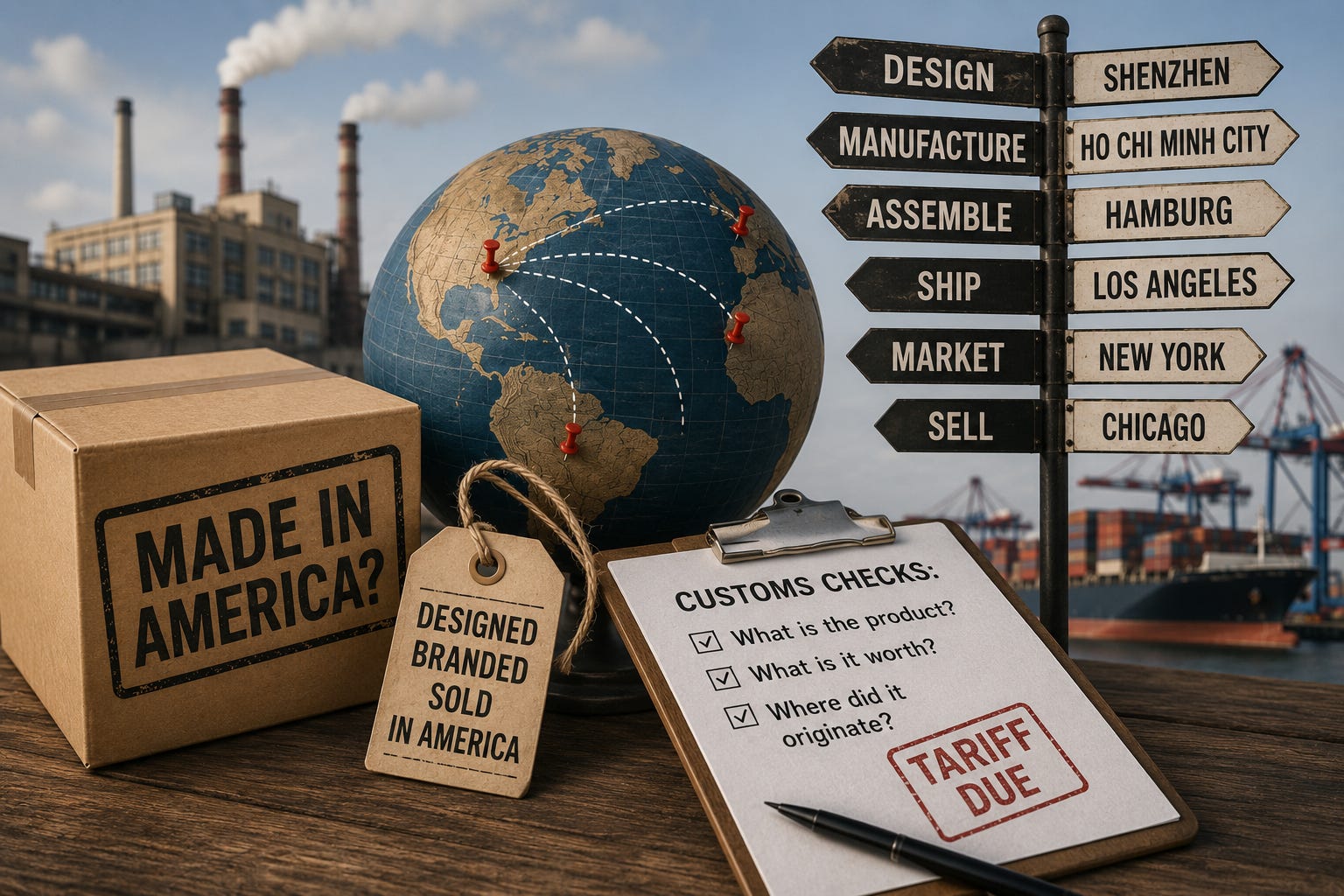
Their products may be designed, branded, marketed, or sold by American companies. But that does not necessarily mean they were made in the U.S.
Apple relies on an enormous worldwide supplier network for materials, manufacturing, and assembly. Its published supplier information covers most of its direct spending in those areas.
Nike designs, markets, and sells its athletic products, but independent contractors manufacture nearly all of its footwear and apparel, primarily in countries such as Vietnam, Indonesia, and China.
Mattel—the company behind Barbie, Hot Wheels, Fisher-Price, and other familiar brands—has operated factories in China, Indonesia, Malaysia, Thailand, and Mexico while also using outside manufacturers.
Target develops and controls more than 40 of its own brands, which generate roughly one-third of its sales. Its sourcing offices help design and manufacture that merchandise, and Target is legally responsible for importing most of its owned and exclusive products.
These companies did not simply discover one morning that their products had wandered overseas. Their executives chose suppliers, approved costs, set specifications, and built those supply chains.
The foreign factory made the product. But an American company often decided which factory would make it.
Why companies manufacture abroad
The usual answer is lower wages. That is often part of it, especially for labor-intensive products such as clothing, shoes, toys, and consumer electronics.
But wages do not explain everything. Companies also manufacture abroad because other countries may offer:
Established supplier networks and experienced workers
Factories capable of producing enormous quantities quickly
Lower costs for land, energy, materials, or taxes—and labor
Export infrastructure and government assistance
Access to foreign customers
Contracting with an existing manufacturer allows an American company to avoid buying land, financing and equipping a plant, hiring the workforce, and carrying the factory through a downturn. It can concentrate on design, branding, marketing, distribution, and finance while shifting much of the production risk elsewhere.
That arrangement has been highly profitable for many companies. It has also helped dismantle parts of America’s manufacturing system.
When factories close, the country loses not only final-assembly jobs. It can also lose component suppliers, tooling companies, technical knowledge, apprenticeship programs, experienced workers, and the local infrastructure that supports production.
Years later, a company cannot necessarily bring the work back merely by renting an empty building and putting out a help-wanted sign.
What Customs sees
When an imported product reaches the U.S., Customs does not primarily ask whether the brand sounds American. It asks:
What is the product?
What is the product worth for tariff purposes?
Where did it legally originate?
An Apple device, Nike shoe, Mattel toy, Target-owned product, or GM component may therefore face a tariff even though an American company controls the brand or supply chain.
According to U.S. Customs and Border Protection, the importer is ultimately responsible for paying any duty owed. That importer may be the American brand owner, a retailer, a distributor, or another company handling the shipment.
The exporting country does not receive a tariff bill from Donald Trump. The Chinese, Vietnamese, Mexican, Canadian, or European government does not normally send money to the U.S. Treasury.
An American importer pays first.
Who eventually bears the cost?
Economists distinguish between who legally pays a tax and who ultimately bears its cost.
The American importer pays the tariff to the government, but paying the tariff first does not necessarily mean bearing its entire economic cost. The importer has choices. It may:
Raise prices
Accept lower profits or reduce other spending
Press the foreign supplier to lower its price
Change suppliers or move production
Drop the product or seek an exemption
The cost can therefore be divided among the importer, foreign producer, retailer, workers, investors, and customers.
Federal Reserve researchers have found that tariffs can reach consumer prices, although the speed and size of the increase vary.
A foreign manufacturer can be harmed. It may lose orders, reduce prices, cut production, or lay off workers. But that is different from saying the foreign country pays the tariff.
The U.S. International Trade Commission found that Trump’s earlier tariffs reduced covered imports from China by an estimated 13% but increased U.S. production across the affected industries by only about 0.4%.
That is not nothing. But it is a long way from rebuilding American manufacturing.
And when companies move production out of China, the work often goes to Vietnam, India, Mexico, or another country rather than returning to the U.S.
Moving production from one foreign country to another is not the same as rebuilding a domestic industry with the factories, suppliers, workers, and technical ability needed to make products here.
American manufacturers can be on both sides
Tariffs do not divide the economy neatly between American winners and foreign losers. They can divide American manufacturers against one another.
Federal Reserve researchers studying the earlier Trump tariffs found that greater protection from imports was offset in some industries by higher material costs and foreign retaliation.
An American steel company may benefit when tariffs make imported steel more expensive. It can sell more domestically produced steel or charge higher prices for it.
But an American automaker or equipment manufacturer buys steel as a raw material. Higher steel prices increase the cost of making its vehicles, machinery, appliances, or tools.
Both are American manufacturers. The tariff protects the company that makes steel while raising costs for companies that make products from steel.
The U.S. International Trade Commission found that steel and aluminum tariffs increased domestic production in the protected industries. It also found that higher metal prices reduced production in industries that use those materials.
GM illustrates both sides. Tariffs may discourage imports of competing vehicles, while tariffs on parts, metals, and systems from Canada, Mexico, or elsewhere may raise costs in its U.S. plants. “American manufacturing” is not one unified interest.
Who benefits?
Tariffs can provide significant benefits to some American companies, workers, and communities.
Protected domestic producers may sell more or raise prices. Their owners and shareholders may earn more, workers may gain hours or job security, and surrounding communities may gain business.
The federal government also collects tariff revenue, while companies receiving exclusions can gain an advantage over competitors that still pay the tariff.
Trade lawyers, customs brokers, consultants, lobbyists, and compliance specialists also gain work from a system whose rules and exemptions keep changing.
These benefits are real. But they are concentrated.
The costs are spread across millions of consumers and thousands of businesses. A family may pay only a few dollars more for one product. A manufacturer may absorb only a small increase on one component. Added together across an economy, however, those costs can be substantial.
This imbalance also affects politics.
A protected company has a powerful reason to lobby for the tariff. Each consumer has much less reason to organize against a modest price increase hidden among hundreds of purchases.
Tariffs can have a legitimate purpose
None of this means tariffs are always useless. A targeted tariff may help respond to:
Unfairly subsidized imports or products sold below fair value
Forced labor or intellectual-property theft
Dependence on unreliable or hostile suppliers
Threats to essential domestic industries
The U.S. may reasonably decide that it needs reliable domestic or allied production of medicines, medical equipment, semiconductors, energy systems, communications equipment, critical minerals, transportation equipment, and defense supplies.
The cheapest possible product is not always the safest or wisest national choice.
But a tariff should be part of a defined strategy. It should answer:
What domestic capacity are we trying to create or preserve?
How will the tariff help create it?
What investments will accompany the tariff?
Who will bear the increased costs?
How long will the protection last?
How will we know whether it worked?
Without those answers, a tariff can become a tax attached to a slogan.
Tariffs tax the border. They do not build the factory.
Studies of Trump’s earlier tariffs do not show that tariffs are powerless. But they also do not show that tariffs alone can supply what domestic manufacturing lacks.
Making imported products more expensive can change a company’s calculations. It cannot by itself provide:
Factories and machinery
Domestic suppliers
Skilled workers
Infrastructure and financing
Reliable customers and stable policy
A company may hesitate to invest hundreds of millions or billions of dollars when tariffs can be imposed, delayed, renegotiated, challenged, replaced, or removed. Factories require more patience and stability than presidential tariff announcements.
What would bring more production home?
Tariffs are only one policy tool. A broader manufacturing strategy would combine targeted trade enforcement with grants, loans, production credits, worker training, government purchasing, and support for domestic supply networks. Together, those policies could make American production more practical, profitable, and durable.
A broader manufacturing strategy would need several parts:
Rebuild supply networks, not only final assembly
Final assembly is not enough. A factory cannot operate competitively if nearly every component, material, machine, and specialized service must still come from abroad.
Policy must support small and midsize manufacturers as well as the large company whose name appears on the finished product.
Train and support workers
Manufacturing requires electricians, engineers, welders, toolmakers, production managers, and maintenance workers. That means supporting apprenticeships, union training, community colleges, vocational education, and paid opportunities for workers changing careers.
It also means addressing housing, transportation, healthcare, and childcare. A factory cannot fill jobs that workers cannot afford to reach or accept.
Use government purchasing power
Federal, state, and local governments purchase vehicles, construction materials, medical supplies, transit equipment, computers, energy systems, and countless other products.
Long-term purchasing commitments can give companies a dependable market if they invest in domestic production.
Attach enforceable conditions to public support
Companies receiving grants, loans, tax benefits, tariff protection, or government contracts should be required to provide measurable public benefits. Those conditions might cover:
Domestic investment and supplier use
Job creation and retention
Wages, benefits, and training
Continued operation for a specified period
Repayment when companies fail to meet their commitments
Public money should purchase more than a ribbon-cutting ceremony.
Reward production, not merely imports avoided
A tariff penalizes an imported product. A production tax credit rewards a company for actually making a qualifying product or component in the U.S.
One raises the cost of what we do not want. The other helps pay for what we do want. A strong strategy may use both, but the second is much closer to the desired result.
Ask who decided and what we receive in return
Consumers can choose American-made products when the information is trustworthy, the product is available, and the cost is manageable. But consumers did not create this system by themselves, and they cannot rebuild manufacturing one shopping cart at a time.
The more important actions are political. When elected officials propose tariffs or manufacturing subsidies, citizens and journalists should ask:
What specific industry or product is the policy intended to support?
What evidence shows that production will move to the U.S. rather than another country?
Which American companies will benefit, and which will pay more?
What jobs, wages, investment, and domestic production will companies be required to provide?
Who may grant exemptions, and will the requests and decisions be public?
When will the policy be evaluated—and will it end if it fails?
We should ask similar questions of the companies whose names we know.
What would Apple need, for example, before it manufactured more components in the U.S.?
When retailers, automakers, or other companies seek tariff relief or public support, what domestic investment, jobs, wages, and long-term commitments should the public receive in return?
These are harder questions than asking whether someone supports tariffs. They are also more useful.
Someone made the choice
Trump’s tariff story begins at the border. The real story begins earlier.
It begins when an American company decides what to make, where to make it, which supplier to hire, what workers and communities to leave behind, and how much long-term risk to accept in exchange for lower immediate costs.
Tariffs may alter that decision. But they do not erase who made it.
And they do not create the factories, suppliers, workers, infrastructure, and dependable demand that American manufacturing needs.
Before we celebrate another tariff as a victory for American workers, we should ask what it is meant to build, who will gain, who will pay, and what companies receiving government protection or support will owe the public in return.
Otherwise, we are not bringing production home. We are merely taxing products after American companies chose to make them somewhere else.
Related resources at Plainly, Garbl
Tax Reform and Public Investment
A ranked guide to advocacy groups working for a fairer tax system and economic opportunity for all.
How to Contact Federal Officials—and Be Heard
Reaching out to the executive branch of the federal government might make a difference—but only if your message gets to the right place and the right people.
Contact Information: Washington’s U.S. Senators and Representatives
To write your members of Congress through email, use the contact form on their website. Phone calls are recommended.