
🔤 Writing Does Not Always Have to Behave
Two odd poems from my typewriter-to-computer years

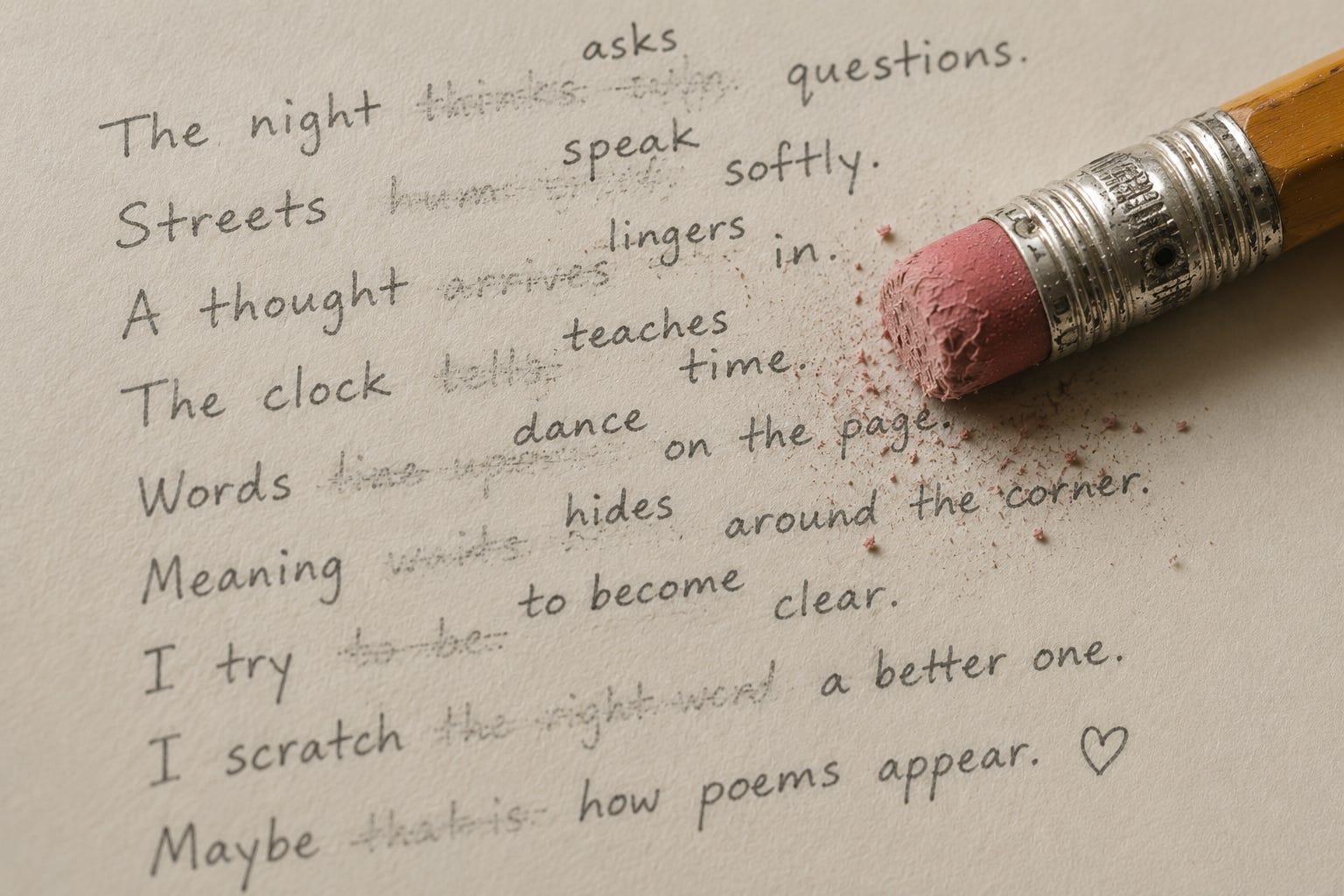
I recently rediscovered a few poems I wrote in the 1980s, during breaks at work, when editors were getting used to shared computers in a large room.
That may not sound revolutionary now. But compared with electric typewriters, those computers felt almost magical. I could move words around. I could change spacing. I could revise without correction tape, retyping, or muttered newsroom profanity.
So I played.
The poems were spontaneous, odd, and not especially disciplined. That may be part of why I still like them. Poetry and I have only been casual acquaintances
But looking back, I can see concerns that still shape my writing: war, development, class, consumer culture, nature, power, and ordinary people caught in systems they did not create.
Not all writing has to be standard journalistic, academic, or professional prose to make a point. Sometimes writing needs to loosen its tie, kick the furniture, and see what falls out.
That does not mean abandoning clarity. It means giving yourself room to experiment before the serious writing begins.
Try a different voice. Break a pattern. Bend a grammar rule on purpose. Write a sentence fragment if it lands harder than a complete sentence. Play with rhythm, repetition, spacing, and surprise. Stick with poetry—or any other form—if that is what keeps you writing.
Not every experiment belongs in a finished essay, report, article, or public statement. But experiments can help you discover images, arguments, phrases, and connections you would not find by marching dutifully from subject to verb to period.
The best time to try that is when no editor, supervisor, client, or deadline is waiting for the final version. Write something that does not have to behave. Then decide later what deserves to stay.
That is one reason I have long liked the pencil as a symbol of creativity: It invites motion. You can try a word, test a sentence, sketch an idea, erase it, and try again. The delete key can do the same thing, though with less charm and no pink eraser.
Clear writing can look simple when it is finished. But getting there often requires some messy, playful, stubborn, rule-testing work first.
Here are a couple of examples from that earlier writing life.
Homes to Houses in One Easy Lesson
The flour mill on top of Cherry Hill
burned to the ground yesterday.

It was the day the new year began,
        and union leaders had said workers could stay away.

But gray Samuel McGovern didn't listen. He was alone
        and had nothing to do—
        so he went to the mill
        as he had done
        since Ruth left his world
after 30 years.

He was in the machine shop when it started,
repairing flywheels and switches
        and making things work.

His foreman had dropped by

but left in a hurry:
        He went to get drunk;
        he didn't want to face
        the future and fates
        of the workers he once knew as friends.

"Too bad about that," said the chairman of the board.
"Oh, it's too bad," said the mayor.
"Yes, it's too bad," said the president of Cherry Hill First National.
"I agree. It really is too bad," said the developer
        of the proposed Cherry Hill Mall.
"I hate to sound redundant, but it is too bad,"
        said Nickerson of Nickerson's Cherry Hill Realty.

On January 2, papers were filed
for a new development.
It was to be Cherry Hill Estates:
        "Get Away from It All," the slogan would say.
And commuters-to-be
        would come in droves.

Portstown was just
        20 minutes away.
"Our Empire's Financial Hub," its promoters called it.
But the briefcase carriers hated it
        and would be happy to move away:
Portstown neighborhoods
        were old and dark,
        and “undesirables” lived there.

Mill workers without jobs
        soon lost their homes
        and moved to Portstown.
The powerful cried, "Arson!" And Samuel McGovern was pulled
        from his hospital bed ...
He was burned again
with the third degree.

The flywheel fixer took the blame:
and the bankers, developers and their lawyers
        lay at home in hammocks
      —and were happy.
Flash Garden Saves Safeway Lot
The steering wheel blares at the driver:
        "Get your hands off me, honky."

The driver ignores the blast
and turns around, instead,
        just in time
        to see the curb
        as his tires roll through
the Viburnum davidii and Oregon grape
planted there.

"Now I've done it," says the driver,
        taking a break
        and smashing the pedal
        to the floor.
"Woooooooooaaaaaaaaaahhhhhhhh, horsepower!"
        he says.

"We're getting really tired of this,"
        say the berries falling from the grape bush.
"Same here,"
        agree the berries
        still clinging barely
to the shrub.

Mother Nature has few kind words
        for parking lot forests.
Scattered across
the wide, open asphalt fields,
        little oases
        crop up.
Heartbroken branches, soiled dirt
        and downtrodden cedar chips
give a poor impression
of evergreen jungles.

"Well, at least they're not plastic,"
        says the grocery store manager.
"Here, buy some petunias and marigolds
      —on  sale now—
        and place them
        in this whiskey barrel
        on your porch.
You, too, can go native."

But the Chevy station wagon
        does not hear or see.
        It flies right past
        and empties its
        2-year-old, 8-year-old and 30-year-old cargo
alongside a stand of flowering cherries.

"Ouch," yelps the driver with a twig in his eye.
"I can't see no forest, let alone a tree!"
His well-trained kids play leapfrog across the ivy.