
📰 Who Owns and Who Operates Washington’s News Media?
A guide to commercial, public, nonprofit, community, Indigenous, and specialized media

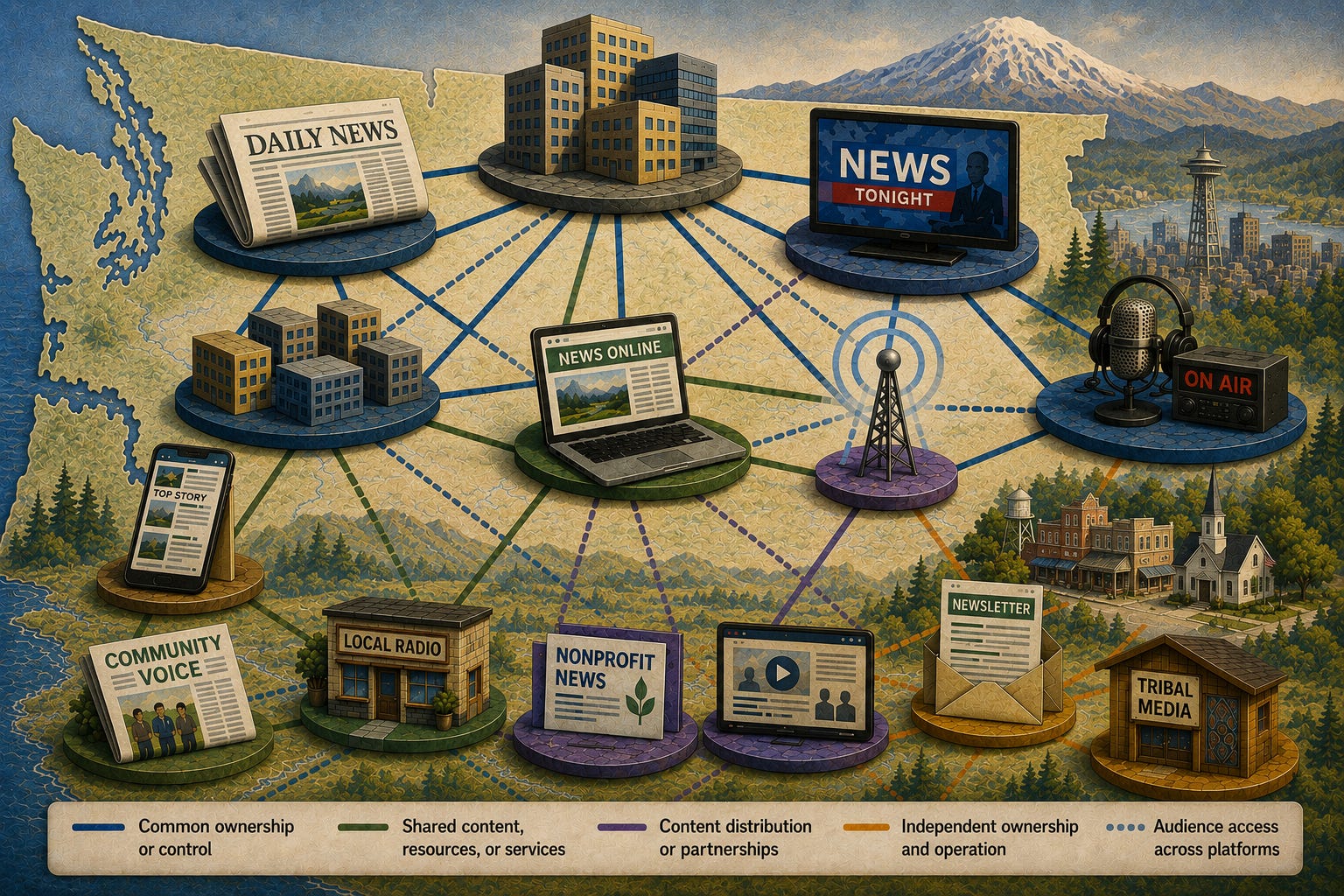
Introduction | Newspapers | Television | Radio | Public/Educational | Independent/Community | Indigenous/Cultural | Specialized
First in a series: This introduction launches the guide. Its seven sections will be published separately.
While studying communications in graduate school during the 1970s, I learned that ownership of American news media was becoming increasingly concentrated. My graduate adviser, who specialized in the economics of journalism and was studying news media consolidation, sparked my interest in the issue.
At the time, consolidation was something I read about. Over the decades that followed, I watched some of its effects unfold.
It worried me then, and it worries me now.
While handling news media relations for a public agency in the 1980s, I routinely dealt with reporters from up to six daily newspapers who covered the local government beat.
Nearly 20 years later, I was working with reporters again, as a public information officer. I interacted most often with reporters from the daily Seattle Times and Seattle Post-Intelligencer, along with reporters from other community newspapers. But even their reporters varied by story, issue, or controversy. I also noticed declining or changing coverage from television and radio.
The daily Seattle P-I ended print publication in 2009. More recently, my involvement with local nonprofit journalism has given me another view of the changing news landscape—and efforts to rebuild local reporting where traditional models have weakened.
Those experiences helped lead me to a question for this project that’s complicated and not easy to answer:
Who owns and who operates the news media serving Washington today, and what does that mean for the people who depend on it?
I undertook this independent, volunteer project out of personal interest and concern about Washington’s news media and the news media generally. My experiences led me to the project. The research did not lessen that concern. It modified and deepened it.
Large national companies now own or operate hundreds of television stations, radio stations, newspapers, and other local news operations. In Washington, familiar local names are sometimes part of companies whose holdings extend across dozens or even hundreds of communities nationwide.
Consolidation can provide financial resources, shared technology, production, advertising, and other resources that help keep some news organizations alive. But it can also bring:
Staff reductions, including fewer reporters, photographers, editors, and other newsroom employees
More management decisions made outside the community
Fewer newsroom resources for reporters, photographers, and editors
Local news operations combined or reduced through shared staffing and production
Less reporting from the communities those media were created to serve
Those changes affect the strength and capacity of the local news operation itself.
Another consequence goes beyond staffing and operations: fewer independent voices.
As ownership becomes concentrated, fewer independent local owners, editors, journalists, and communities have separate voices in deciding what gets covered, which issues get sustained attention, whose perspectives are heard, and what analysis or commentary appears.
Corporate owners may influence what their local media cover, emphasize, analyze, or comment on. They may also distribute the same news or commentary across many separately branded local media.
That does not mean every outlet within a chain sounds the same or that local journalists lose all editorial independence. But greater concentration can reduce the number of distinct local voices while increasing a corporate owner’s influence over coverage, analysis, and commentary.
That is one reason ownership matters.
But this project also showed me that Washington’s news media cannot be understood simply as a story of corporate consolidation.
Alongside large commercial chains, the state also has:
Locally and family-owned newspapers and broadcasters
Public and educational media
Nonprofit newsrooms
Community-operated and volunteer-supported outlets
Indigenous and culturally specific media
Specialized public-interest organizations
Some are longstanding institutions. Others have emerged recently in response to shrinking newsrooms, disappearing publications, changing technologies, and communities that believe important people, places, or subjects are not getting enough attention.
That part of the picture gives me hope.
The internet helped undermine the advertising and subscription models that supported traditional newspapers and broadcasters, but it also lowered many of the barriers to creating and distributing journalism.
A news organization no longer needs a printing press or broadcast license to reach an audience. Digital publications, nonprofit newsrooms, newsletters, podcasts, video services, community media, and independent journalists can now provide reporting that once required much larger institutions.
Whether those newer forms of journalism can replace what is being lost is another question.
The audience is changing, too.
Younger people, in particular, are less likely than older generations to rely primarily on newspapers, television newscasts, or radio for news and information. They increasingly get news through social media, online video, podcasts, news creators, influencers, and other digital sources.
There is opportunity in that change:
Important journalism can reach people through more channels and from more voices than ever before.
Communities historically overlooked or misrepresented by mainstream media can create and control their own sources of news and information.
Specialized journalists can provide sustained expertise on subjects that shrinking general-interest newsrooms may no longer have the staff to cover deeply.
But abundance is not the same as reliability. The same digital systems that distribute excellent journalism also spread rumor, propaganda, misinformation, partisan manipulation, and commentary that can be difficult to distinguish from reporting.
And even the best new journalism cannot strengthen public life if too few people find it, trust it, support it, or pay attention to it.
That makes the future of news partly an ownership problem and partly an audience problem.
A healthy information system needs more than surviving media companies. It needs enough independent sources of reliable journalism, enough resources to cover communities and institutions well, and enough people willing to seek out, subscribe to, and otherwise support that work.
This matters far beyond the news business:
Democratic government depends on people having access to dependable information about what public officials, institutions, businesses, organizations, and other people are doing.
Local journalism covers city councils, school boards, courts, elections, public agencies, businesses, neighborhoods, and community life.
State and regional journalism connects those local decisions to larger systems.
Investigative and specialized journalism examines subjects that may require months of work or expertise that no small local newsroom can maintain.
When that reporting disappears, the loss is not merely fewer articles or newscasts. Communities lose independent scrutiny, shared information, institutional memory, and some of the knowledge people need to participate effectively in public life.
That concern is what makes this ownership guide more than a directory of companies and outlets.
The profiles in this guide examine selected Washington news media: who owns or operates them, what those organizations control, whom they serve, how their news operations work, and what their ownership or operating structures may mean for audiences. The guides are based on publicly available online information.
The structures vary widely:
A newspaper may be owned by a national corporation, a local family, an individual, or a nonprofit organization.
A television station may be owned by one company, affiliated with a national network, and operated in cooperation with another broadcaster.
Public media may be licensed by universities, colleges, nonprofit organizations, or governments.
Tribal media may combine journalism, cultural preservation, public information, and communication within sovereign nations.
Some nonprofit and specialized outlets operate as parts of broader networks while retaining locally directed reporting.
Those differences are important. Ownership alone cannot tell us whether an individual news story is accurate, fair, useful, biased, shallow, or excellent. Nor does common ownership mean that every newsroom produces identical coverage.
But knowing who owns, operates, funds, or controls a news organization gives audiences important context for understanding the journalism they receive.
First in a series: This introduction launches the guide. Its seven sections will be published separately.
Table of Contents
This guide is organized into seven sections, each examining a different part of Washington’s news-media landscape.
Newspapers and Other News Publications—Consolidation, local ownership, shared operations, and surviving local newsrooms.
Commercial Television News—Ownership, operation, network affiliations, and sources of local television news.
Commercial News Radio—How much news is produced locally, regionally, or nationally.
Public and Educational Media—Different relationships among public service, institutional support, and editorial independence.
Independent and Community Media—Local control, nonprofit models, community participation, and financial vulnerability.
Indigenous and Culturally Specific Media—Journalism shaped by communities’ own experiences, histories, and perspectives.
Specialized Public-Interest Media—Depth, expertise, investigation, analysis, and sustained attention to particular issues.
Related Resources at Plainly, Garbl
For additional media-literacy resources to help you evaluate news and select credible sources, see Media and Journalism Tools. It covers nonprofit news, progressive media, moderate and conservative media, news credibility and bias, fact-checking, and other topics.
How this guide was researched and created
I developed this guide through extensive collaboration with ChatGPT, which I used primarily as a research assistant.
Working from my direction, questions, comments, and requests, ChatGPT helped identify media organizations, trace ownership and operating relationships, locate and compare publicly available sources, investigate complex corporate structures, and bring consistency to information spread across many profiles.
I did not simply accept and publish what AI produced. I reviewed and edited the material, visited media and company websites, checked selected sources and ownership details, compared conflicting information, researched unclear points, corrected errors, and made the final decisions about what to include and how to describe it.
That checking was essential. AI can make mistakes, miss context, rely on outdated information, or sound more certain than the evidence warrants. Publicly available information can also be incomplete, unclear, or changing, particularly when ownership and operating relationships are complicated.
I could not have produced a resource this broad and detailed within a reasonable amount of time without AI assistance. ChatGPT expanded the reach and speed of the research; I remained responsible for checking, interpreting, editing, and publishing the results.