
✍️ The Test of Our Self-Government After 250 Years
Party labels do not prove respect for republican government or democratic self-rule.

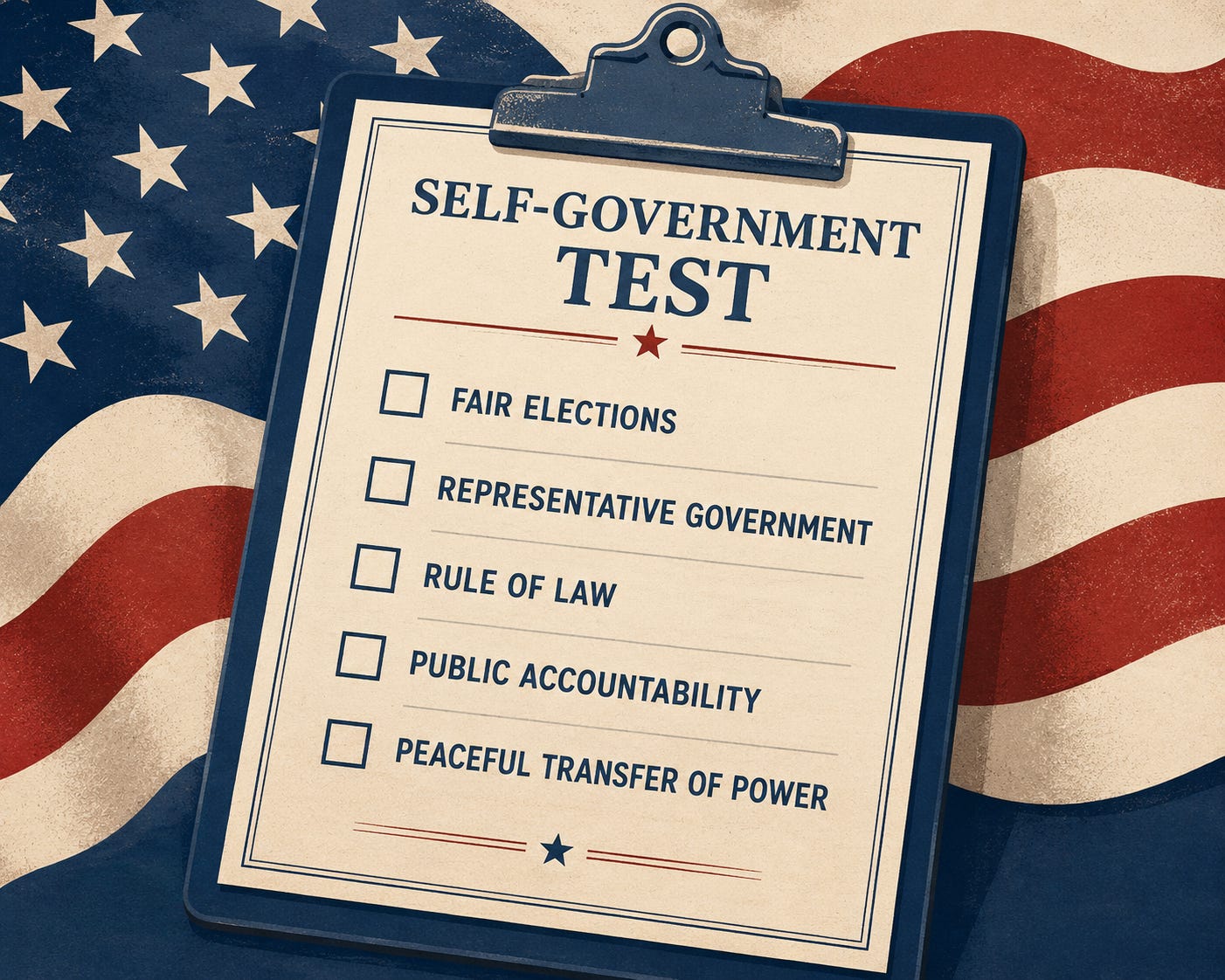
We sometimes hear about small-r republicans and small-d democrats. Those words can sound odd in a country where Republican and Democratic refer to political parties, candidates, campaign signs, and cable-news arguments.
But those words began as descriptions of government, not party brands.
A Republican candidate is not the same thing as republican government. A Democratic candidate is not the same thing as democratic self-rule.
The party labels may tell us who is running. They do not, by themselves, tell us who respects representative government.
That test has to be earned.
As the United States approaches the 250th anniversary of the Declaration of Independence, that distinction is worth remembering. The Declaration did not celebrate party labels. It asserted that governments derive their just powers from the consent of the governed.
That principle still asks something of us: Who respects the people’s right to govern themselves, and who only wants power in the people’s name?
What republican meant
In the founding era, a republic meant government without a king, with public power exercised through representatives chosen by the people. It did not mean government by one ruler. It did not mean a direct public vote on every law.
James Madison made that distinction in Federalist No. 10. He described a republic as a system where government is delegated to a smaller number of citizens elected by the rest. He contrasted that with what he called “pure democracy,” meaning direct rule by citizens gathered to decide public questions themselves.
That old distinction can sound strange today because we often use democracy more broadly. We call the United States a democracy because the people are supposed to govern through elections, rights, public debate, and accountable institutions.
But the Constitution itself does not use the words democracy or democratic. It does use republican in Article IV, which says the United States shall guarantee every state a “Republican Form of Government.”
In plain English, that means representative government.
That does not make the United States less democratic in the modern sense. It means the Constitution’s structure is representative. The people govern but not by voting on every bill, budget, court case, treaty, or regulation. They govern through elected officials, the separation of powers, public pressure, and the rule of law.
What democratic means now
Today, small-d democratic usually means more than holding elections.
It includes the right to vote, fair access to the ballot, the rule of law, peaceful transfer of power, equal protection under the law, freedom of speech, freedom of the press, public accountability, and respect for election results.
A country can hold elections and still fail democratic tests. If voters are threatened, districts are rigged beyond recognition, courts are captured, opposition leaders are punished, journalists are intimidated, or officials refuse to accept lawful election results, democracy is weakened even if ballots still exist.
That is why the word democratic should not be treated as a decoration. It is a standard.
What federal meant
Another founding-era word belongs in this conversation: federal.
Federalism is the division of power between the national government and the states. The Constitution created a stronger national government than the one under the original Articles of Confederation. But it did not eliminate the states. Madison argued in Federalist No. 39 that the proposed Constitution was partly national and partly federal.
That tension is still with us.
Federal, state, and local power all shape people’s rights and daily lives. Civil rights can be protected or damaged at every level.
So when we talk about republican government and democratic self-rule, we are not talking only about the White House or Congress. We are also talking about state legislatures, governors, courts, county officials, city councils, school boards, election administrators, and the people who push them to do their jobs.
The names of today’s political parties do not settle any of these questions. A party label can tell us who is running but not whether that candidate respects representative government, voting rights, the rule of law, lawful limits, and public accountability.
That test has to be applied to everyone who seeks power. Applying the same test to everyone does not mean pretending everyone is passing it.
A party, candidate, or movement that undermines voting rights, excuses political intimidation, treats legislatures as rubber stamps, or refuses to accept lawful election results is failing the test, whatever name it uses.
That brings us back to representation.
The representation test
In our constitutional system, the branch most built for representation is the legislative branch: Congress nationally and state legislatures. Presidents and governors can lead, propose, persuade, administer, veto, and respond to emergencies. But they are single executives.
Legislatures are different. They are made up of many elected people from many places, each tied to a district, state, or community. That does not mean they always listen or represent people well. It means representation is built into their structure.
That structure is the point.
When legislative bodies are ignored, bypassed, gerrymandered, intimidated, or turned into rubber stamps for one leader, republican government is weakened.
When voting is restricted, election results are denied, public servants are threatened, and citizens are treated as enemies instead of participants, democratic self-rule is weakened.
That is where the old words become real. They have to be practiced, defended, and demanded.
The question is not simply whether a candidate has an R or a D after a name. The question is whether that candidate respects the people’s right to govern themselves through fair elections, representative institutions, lawful limits, and public accountability.
That is the test.
Gary, I appreciate your straightforward, matter of fact presentation on these core concepts. We should not assume people remember or fully understand what they once learned in Civics class.