
✍️ The Power Buried in Article II
Why Congress, the states, the news media, and citizens must confront presidential power

I’ve been fascinated by the U.S. presidency since I was a kid. I recall collecting Carnation Milk bottle caps with small images and bits of information about each president. I recall cutting “baseball” cards of the presidents from the backs of cereal boxes. Social studies was my favorite subject from the beginning.
Skip forward a few years, to when my family moved into a new home. Left behind on a bookcase were a bunch of books written by Theodore Roosevelt, including his autobiography. I read some of them and was hooked on him as an energetic man and president who was concerned about nature and conservation.
He continues to be a political idol of mine for his progressive principles, including his belief that government should control the power of great corporations and concentrated wealth. His aggressive military interests continue to bother me, though he also earned the Nobel Peace Prize for helping negotiate an end to the Russo-Japanese War.
But I don’t want to dwell too much on Teddy.
My dad was a Democrat and a union member, and I recall him crying after John F. Kennedy was assassinated in 1963. More attention to a president.
Robert F. Kennedy, his younger brother, became another idol of mine as he ran for president, opposed the Vietnam War, and showed compassion for people in need. Like my dad after JFK’s death, I was heartbroken by the assassination of RFK.
In high school and college, I continued to recognize the power of presidents, not just in the U.S. government but in student government. While in college, I wrote about student-government presidents for the student newspaper, was elected president of my dorm, and served as vice president of the college student government.
But I began to realize that presidents weren’t always the good guys.
Although I admired Lyndon Johnson’s Great Society, he also got us more and more deeply stuck in the Vietnam War. His successor, Richard Nixon, continued that war for four more years before signing the agreement that ended direct U.S. military involvement.
Then Watergate drove Nixon from the presidency. Public opinion played an important role, but so did investigative journalism, criminal investigations, congressional hearings, court rulings, and the growing likelihood that Congress would impeach and remove him.
For the first time, I saw clearly that presidents could be self-centered men who sought personal power for its own sake—or simply to satisfy their own egos.
But I continued to buy into campaigning for presidents—all Democrats—as the terms went by. Along the way, I learned that presidents—especially Republican presidents, from my perspective—didn’t always have the public interest or public preferences in mind. They certainly didn’t support my beliefs about government and its responsibilities.
Reagan. The Bushes. And now Trump.
Trump is the worst president in the history of the United States. I won’t say more about him here.
But I will say that it’s too bad we didn’t have bottle caps and baseball cards for other leaders in our government. Honorable, effective leaders exist in Congress, state governments, and elsewhere. And their offices possess powers that should not be overshadowed by the presidency.
They must use those powers, and citizens and the news media should expect them to.
I haven’t mentioned it yet, but as a journalist and political science major in college, I also began getting acquainted with the U.S. Constitution. I haven’t stopped returning to it occasionally.
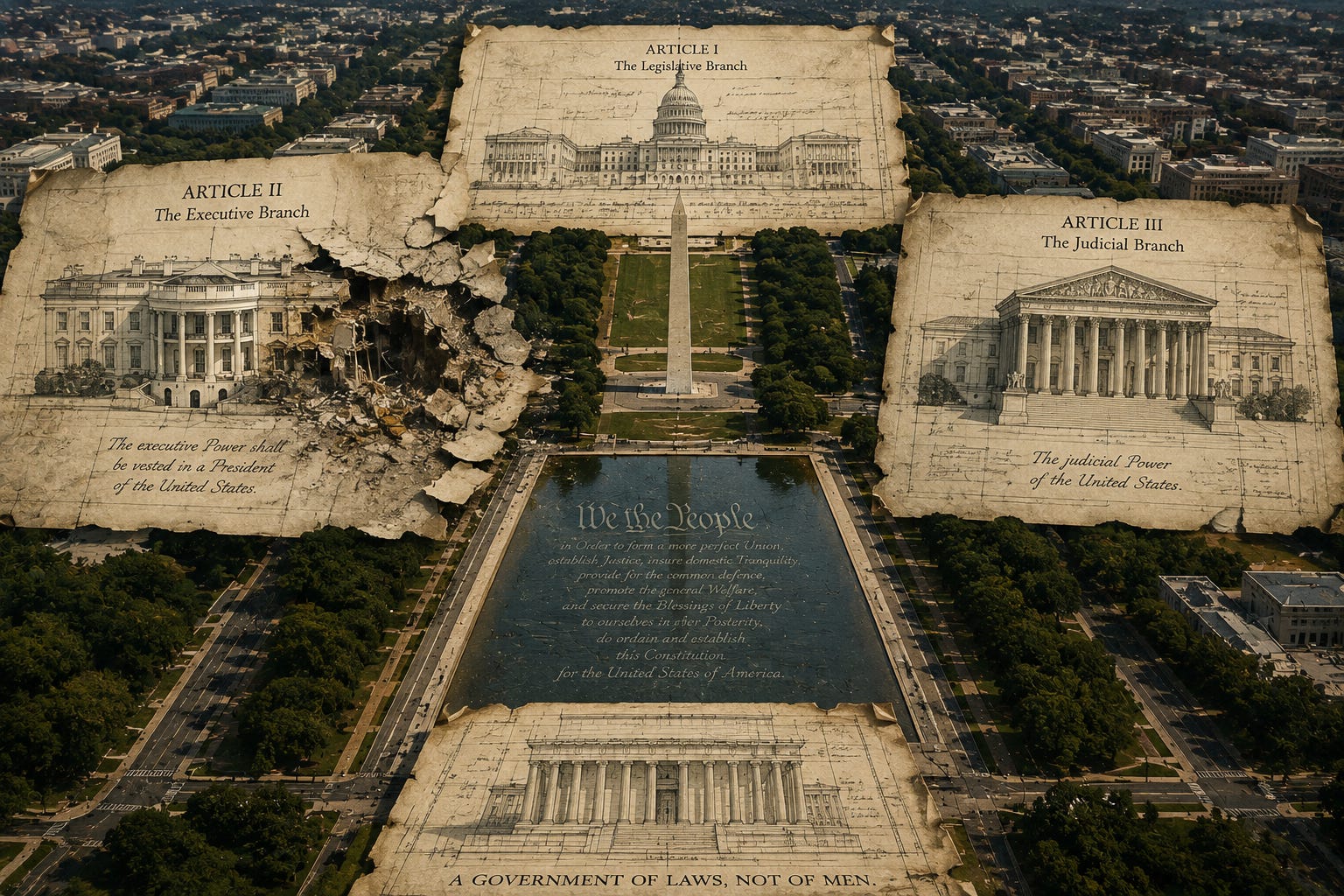
Although political news coverage—and I—have paid an inordinate amount of attention to presidents, it is clear that the country’s founders did not construct a government centered entirely on that office.
The presidency was one part of a federal government divided among three branches, with additional powers reserved to the states and the people. The branches were given separate, differing, and balanced powers.
Not necessarily equal powers. It’s not as if the framers divided a basket of apples into three equal piles. Each branch bears its own fruit.
Congress comes first in the Constitution. Article I is devoted to the legislative branch, and its first sentence vests federal legislative powers in Congress. Article I, Section 8, then provides a relatively clear enumeration of congressional powers, with additional powers and responsibilities appearing elsewhere in the document.
Article II, establishing the executive branch, is much shorter. It does identify presidential powers: serving as commander in chief, granting pardons, making treaties and appointments with Senate approval, filling certain vacancies, recommending measures to Congress, and vetoing legislation through the process described in Article I.
But the powers and duties of the presidency are not presented in one extended catalog comparable to the list of congressional powers.
They are distributed among several sections and paragraphs. Some are quite specific. Others consist of a few broad words that generations of presidents, lawyers, scholars, and judges have interpreted and debated.
Article III, establishing the judiciary, is shorter still. It creates the Supreme Court but leaves Congress to decide whether to establish lower federal courts and says little about how judicial power would be exercised.
The Supreme Court itself would eventually define much of that authority, including its power to declare laws and executive actions unconstitutional.
Over time, the Supreme Court has sometimes limited presidential power and sometimes expanded it. It has also limited and expanded the powers of Congress.
The current Supreme Court has gone much further in protecting presidential power. In Trump v. United States, it ruled that former presidents have absolute immunity from criminal prosecution for conduct within their exclusive constitutional authority, presumptive immunity for other official acts, and no immunity for unofficial acts.
That ruling does not give a president complete immunity for every crime. But it creates formidable barriers to prosecuting a president for breaking or abusing the laws he is constitutionally responsible for carrying out.
And that brings me to one of the most consequential passages in Article II.
The Constitution says the president “shall take Care that the Laws be faithfully executed.”
Constitutional scholars, justices, presidents, and presidential advisers have built extensive arguments about executive power upon those words. The duty to execute the laws is central to the office. It has become a principal source of presidential authority over the enormous executive branch that performs much of the federal government’s daily work.
Yet that clause is literally buried in Article II.
It does not appear at the beginning of the article. It is not announced in a separate section devoted to the president’s overriding authority.
It appears in Section 3, toward the end of a paragraph that also directs the president to provide information to Congress, recommend legislation, convene Congress under extraordinary circumstances, receive ambassadors, and commission federal officers.
I am reading the Constitution as an editor as well as a citizen. Writers do not merely select words. They arrange them. They influence their significance. They decide what comes first, what gets its own heading or section, what is grouped with something else, and what receives emphasis through placement and repetition.
The Constitution’s writers were not unanimous about the proper power of the presidency.
They were creating a new office, rejecting monarchy while also trying to establish an executive strong enough to administer the government. Their disagreements and compromises are reflected not only in what the Constitution says but also, in my reading, in how it is constructed.
Congress is addressed first and at greatest length. Its legislative powers are enumerated. The president’s powers and duties are more compactly and sometimes more ambiguously expressed.
That does not mean the responsibility to execute the laws is unimportant. It may mean something closer to the opposite: The responsibility is enormous, but it is still a responsibility, not a grant of ownership over the laws.
Congress enacts the laws. The president does not get to replace them with personal preferences or carry them out however he sees fit.
One word in the Take Care Clause matters especially: faithfully.
The president is not instructed merely to execute the laws. The president must execute them faithfully, according to the Constitution and the laws themselves. Not according to personal interests, political convenience, or a belief that winning an election confers unlimited authority.
Perhaps the writers placed that immense responsibility where they did because they did not intend it to define the entire office. They did not design the presidency to dominate the government they were constructing.
I cannot prove that conclusion merely from the arrangement of the words. The Constitution was the product of many authors, disagreements, revisions, and compromises. But its structure still tells us something.
It does not present a president who stands above the government, commands its other branches, or embodies the nation by himself.
Nor does it reduce Congress, the states, the courts, or the people to supporting players awaiting presidential direction.
It presents a president who occupies one office within a divided government. That person is entrusted, not entitled, to exercise executive power faithfully.
It’s up to the rest of us to demand that the president do so—and to exercise the powers, rights, and responsibilities that are already ours.
For further reading
Constitution Annotated: Article II, Executive Branch — Congress.gov