

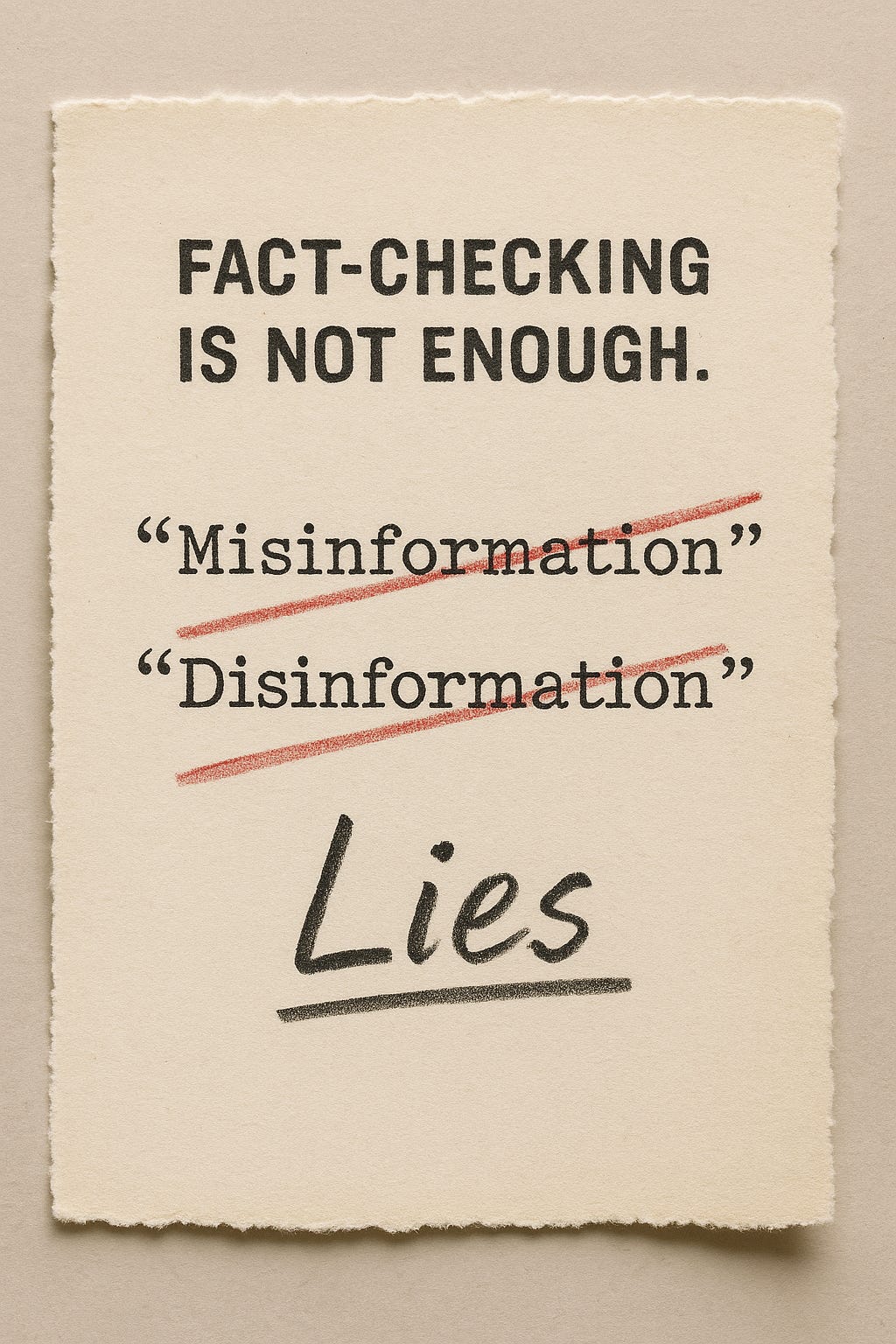
It’s time to be blunt: Fact-checking isn’t enough anymore.
When Donald Trump, his staff, or any elected official intentionally spreads something they know to be false, that is not “misinformation” or “disinformation.” Those terms — often used for unverified facts or distortion — end up softening the impact of deliberate deception.
When someone knowingly spreads false claims, they are lying — and the public deserves clear, concise language that says so, not terms like “unsupported arguments.”
I suppose “misinformation” and “disinformation” have legitimate uses in research and policy circles. But if you must use them, define them immediately and connect them to the behavior they represent: the spreading of lies or intentional lying.
Otherwise, the terminology works like a linguistic buffer that shields powerful people from accountability. Don’t cloak lies in camouflage.
This clarity by journalists is essential whether they work at a community weekly, a statehouse bureau, a major newspaper, a broadcast newsroom, or a podcast studio.
And let’s put to rest the idea that a false statement might simply be unintentional.
When an elected official, cabinet secretary, or department director stands at a lectern, posts to social media, or gives an interview, they’re speaking with authority. They have a responsibility to know whether what they’re saying is true. If they don’t know, the honest response is straightforward: “I don’t know,” or “I need to confirm the facts.”
Anything else is evasion — and voters understand evasion for what it is.
Journalism’s job — especially in chaotic political times — is to offer clarity, not polite euphemisms. Calling lies “lies” is not partisan. It is responsible reporting. And so is providing the truth — the facts — at the same time.
When the public square is flooded with “deliberate falsehoods,” journalists can’t tiptoe around the word “lie.” We depend on them to help us see what’s real. Say it plainly.
Note to readers: If this message resonates with you, consider sending a version of it as a letter to your local newspaper, public radio newsroom, TV station, or a journalist you follow. Newsrooms pay attention when the audience asks them to use stronger, clearer language.
Strengthen Your Information Defenses
Journalists have a responsibility to be clear and honest — and the rest of us need to stay alert to political manipulation, evasive language, and manufactured narratives. These resources can help you cut through noise and recognize the tactics that undermine democratic communication:
The Truth Toolkit: Fact-Checking Resources for Informed Resistance
Evaluating the Evaluators: A Guide to Media Analysis & Bias Rating Resources
Get new posts from Plainly, Garbl delivered to your inbox.