
✍️ The MAGA Infection: Distrust Is the Point
Trump wants us to stop trusting one another

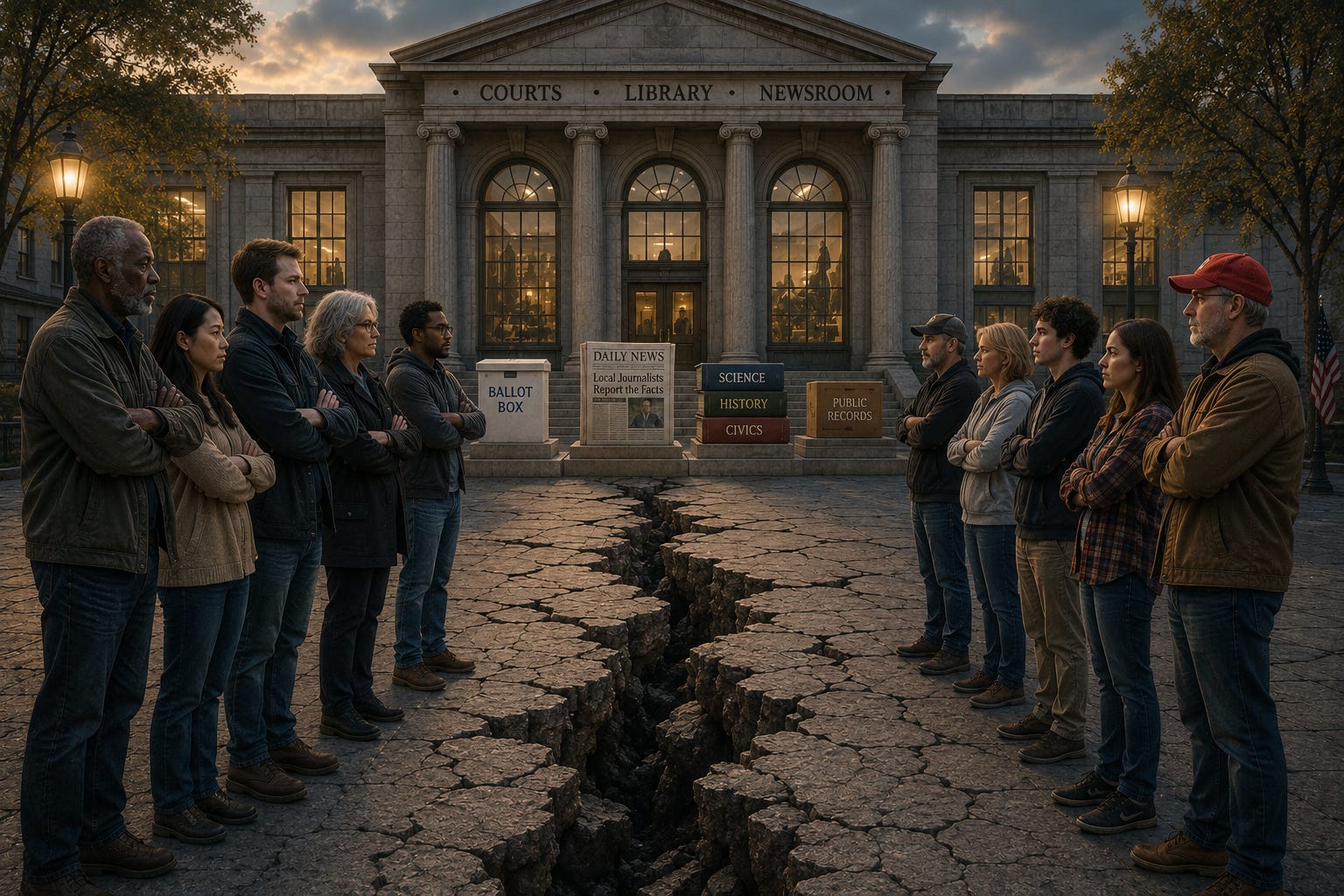
Donald Trump does not need to turn every American into a red-hat loyalist.
He does not need everyone to chant at rallies, repeat conspiracy theories, or cheer cruelty as strength. Trumpism does not have to make everyone bigoted, selfish, or ignorant. That would be too obvious.
He only needs to make enough of us think like MAGA skeptics: distrust government, journalism, courts, universities, science, public records, elections, expertise, and one another. Distrust even the idea of public service.
Once that happens, democracy has no common ground left to stand on.
The greater danger is that it spreads cynicism. It says every institution is corrupt, every journalist is lying, every scientist is political, every court is rigged, every election is suspect unless “we” win. Every fact is just somebody’s opinion wearing a lab coat.
That is how democratic society gets hollowed out.
My journalism training and experience taught me not to trust sources unquestioningly. It taught me to be skeptical, not cynical.
Check the quote. Confirm the fact. Look for the original document. Ask who benefits. Check whether a website is credible. Notice what is missing. Call one more source. Read past the headline. Correct the error.
That is not distrust. That is the work of accuracy.
Democracy needs that kind of skepticism, not just among journalists but also among all of us.
It does not need the manufactured cynicism that says every institution is corrupt, every expert is lying, every journalist is fake, every court is rigged, and every fact is just another political weapon.
Social media makes it easy to spread lies, half-truths, rumors, innuendo, and careless mistakes faster than truth can catch up. Trump and his administration have shown how effectively that system can be exploited.
Even fact-checking can become part of the problem when it repeats the falsehood more loudly than the truth. Corrections should be clear, accurate, and honest, but they should lead with what is true.
Otherwise, deceit keeps doing its work. It makes people wonder: Who do we believe? Can we believe anyone?
That is the distrust Trumpism feeds on.
Healthy skepticism asks questions and checks facts. MAGA-style cynicism dismisses answers and facts before they can be checked.
That is the heart of it.
A democracy needs skepticism. Citizens should question government, journalism, universities, courts, corporations, science, and other expertise. Blind trust is not democracy.
But corrosive distrust is different. It does not ask, “What is true?” It says, “Nothing is true unless my side says it.” It does not demand better institutions. It teaches people to give up on institutions altogether.
That difference—between skepticism and cynicism—shows up in several ways.
Skepticism is necessary. Cynicism is the trap.
We should not worship institutions. Government makes mistakes. Media outlets fail. Universities can be elitist. Science can be misused. Courts can be political. But the answer is accountability, not arson.
MAGA turns every referee into an enemy.
Election officials, judges, journalists, scientists, teachers, civil servants—anyone who can check power becomes part of “the deep state,” “fake news,” “woke academia,” or some other cartoon villain.
The goal is not truth. The goal is dependence.
Once people distrust every outside source, they become dependent on the leader, the party, the influencer. That is the con. Old trick. New hat.
This warning is not only about Trump supporters. Distrust of institutions did not begin with MAGA.
Opponents can absorb the poison too.
People who oppose Trump can also be worn down by cynicism, including the cynicism he spreads. We can begin to assume every institution is already lost, every public servant has already failed, every news source is useless, and every legal process is only theater.
That is understandable. It is also dangerous. That despair helps authoritarian politics.
Many judges still follow the law. Many journalists still dig for facts. Many public employees still protect records, administer programs, count votes, and serve the public. Many citizens still show up.
Democracy does not survive because institutions are perfect. It survives because people keep pushing them to work. We do not have to agree on everything to rebuild trust in the things that help us find out what is true.
The goal is not blind trust.
The goal is repair: build trustworthy institutions, demand evidence and accountability, and defend the people and processes still doing their jobs.
But we should also recognize the trap being set for us.
When every source of shared knowledge is dismissed as corrupt, the loudest voice wins. When every referee is called rigged, only power is left.
And when democracy loses trust—not blind trust but earned trust—it does not become freer.
It becomes easier to rule.
Ask tough questions. But ask them honestly.
Related Resources at Plainly, Garbl
If You’re Concerned About Bias, Check for Accuracy
How to read the news without losing trust in the facts
The Truth Toolkit: Fact-Checking Resources for Informed Resistance
Understanding where to find reliable fact-checking resources is more critical than ever.
Evaluating the Evaluators: A Guide to Media Analysis and Bias Rating Resources
Understanding the watchdogs that track journalism’s trustworthiness
Excellent advice, but there's also this: https://theashlandchronicle.com/warning-trumps-rolling-coup-is-underway-robert-reich-others/