
✍️ The Horse Race Ends. Governing Begins.
How treating elections like a game gets in the way of governing

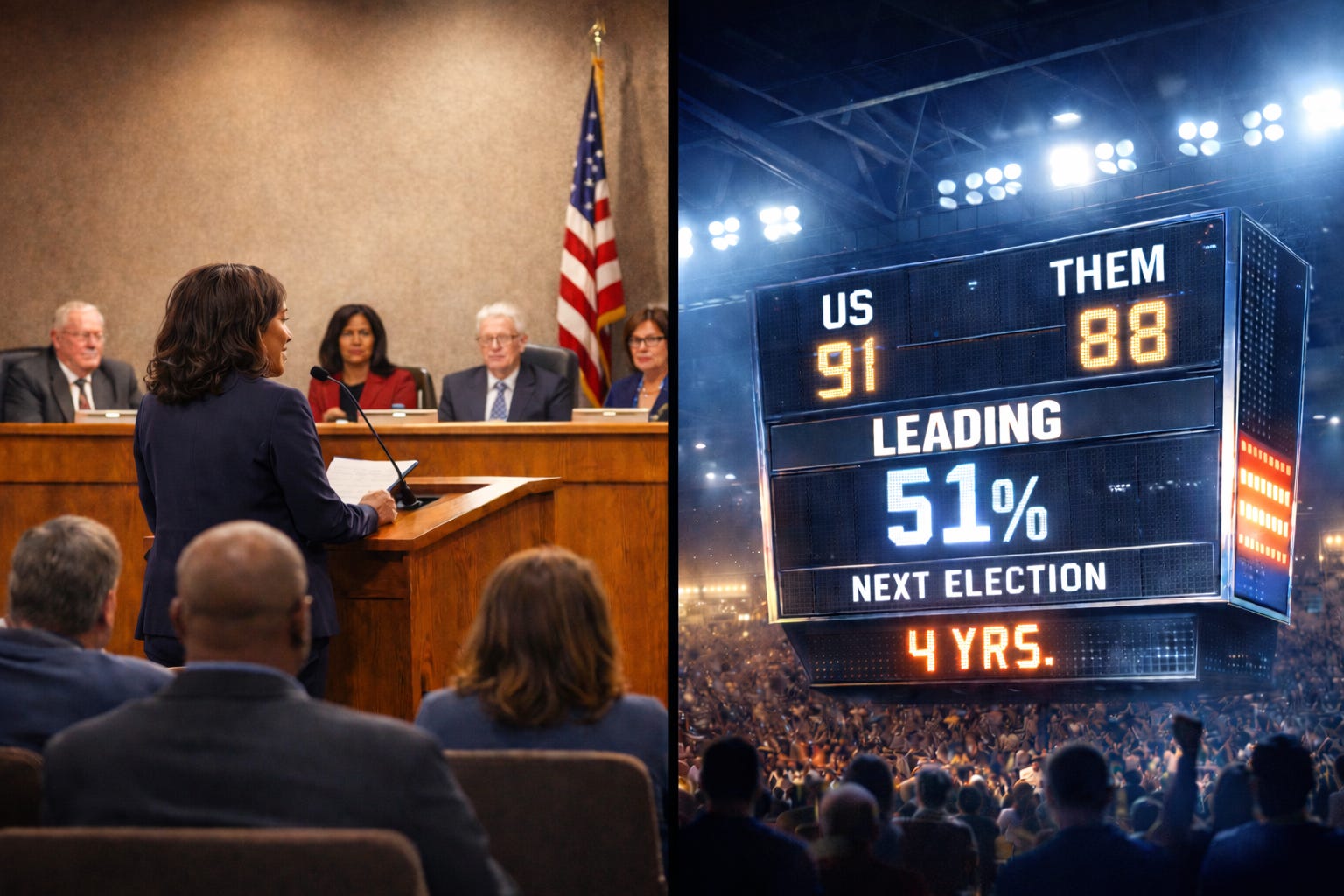
Turn on political coverage during an election season, and you might think you’re watching a game.
The language sounds familiar: Who’s ahead, who’s behind, who’s gaining momentum, who’s slipping. Candidates become front-runners. Polls become scoreboards. Commentators decide who “won the week.”
The news media lean heavily into this horse-race framing because it’s easy to follow and easy to sell. Political parties often lean into it, too, because competition energizes donors and voters.
It can feel less like civic decision-making and more like a running play-by-play. We don’t just describe elections this way; we start to treat them that way.
Elections are contests. That part is true. They involve strategy, competition, and, ultimately, winners and losers.
But democracy is not a sporting event.
Three different things
It helps to separate three things we often lump together. Elections choose leaders. Politics is the competition over ideas, priorities, and power. Governing is the responsibility that begins after the votes are counted.
The word politics doesn’t help much. It’s often used as a catchall: “I’m sick of politics,” or “That’s just politics.” People may mean campaign combat, partisan gamesmanship, or even government itself. Those are not the same. Blurring them together makes it easier to dismiss the entire system instead of expecting it to work better.
Politics isn’t just a game people play. It’s how we decide how to live together.
The problem comes when the competitive mindset of campaigns carries over into governing.
When language shapes the outcome
You can see it in the language. Terms like “front-runner,” “surging,” “slipping,” and “momentum” don’t just describe a race. They can shape it—steering attention, donor confidence, and media coverage toward candidates already ahead. And candidates with different ideas or stronger local ties struggle to break through.
That kind of framing narrows the field before voters have fully weighed their choices. It also rewards familiarity and incumbency, sometimes more than judgment or ideas.
After the election
The same mindset shows up after the election. Winning is often treated as total victory. Losing is treated as total defeat. Governing becomes an extension of the campaign, a chance to reward supporters, sideline opponents, and keep score.
That may work in sports. It doesn’t work in a democracy.
In a game, the losing team goes home. The fans regroup and wait for next season.
In a country, the people who supported the losing side still live here.
They still pay taxes. They still rely on public services. They still send children to school, drive on public roads, depend on public safety, and expect their government to function. They don’t become spectators just because their candidate didn’t win.
That’s why governing cannot be treated as a continuation of the contest.
Public office carries an obligation that goes beyond winning.
It means making decisions that affect everyone, not just the people who voted for you. It means recognizing that disagreement is part of democracy, not a reason to dismiss or ignore large parts of the public.
The way we talk about elections can make that harder. When coverage focuses on who’s ahead instead of what they plan to do, it trains us to think like fans instead of citizens.
Democracy is not meant to be a spectator sport. It depends on citizens who pay attention, take part, and expect to be represented—not fans watching from the sidelines while others keep score.
When political leaders act as if victory gives them exclusive ownership of the outcome, it reinforces the idea that governing is about winning, not serving.
We should expect more.
Voters have every right to choose sides in an election. That’s how democracy works. But after Election Day, the standard should change.
Less scorekeeping. Less chest-thumping. Less treating fellow Americans as defeated opponents.
More evidence that governing still means serving everyone who lives here.
The horse race may make for good headlines.
But once it’s over, the job is to govern.
Gary, I think that you may miss the point that we don't live in a democracy we live in a republic. The government we have has never been based on anything other than a winner take all. Whatever the criticisms one might have of parliamentary systems around the world, the one thing they do allow is minority parties to gain power in a way that allows to have a lot more flexibility and ownership by the voters. We have chosen to tell voters that if their candidate loses they have no power anymore. You have to just put up with it until the next election. Add to that the need for 24 hour new cycles and the never-ending expanding gambling society that we have created and you have a perfect storm recipe for what the voters want to hear at any given moment. Follow the odds for the next election online because they're there all the time. We deserve the politics we get and we get the politics we deserve George Carlin once said. I couldn't agree more. The current inept batch of politicians we have at the local state and federal level is sort of shocking when you really look at it. Our own federal representative didn't even show up for the vote that killed NPR and billions of dollars of foreign aid that her single vote could've saved. She has never accounted for why she wasn't there. At my age I've become so cynical about politics anymore but I don't even see any reason to participate. I don't believe anybody is actually acting in my interest anymore. The Democrats seem to be the anti-semetic party racing to get the Palestinian vote, the very people who are responsible in a couple of states for Trump winning and the Republicans well they're just totally incapable of ruling anything. So if it's a gambling game that they want I really don't care I don't gamble. I was raised in horse racing I know who loses and it's always the two dollar bettor.