
✍️ The First Amendment Is More Than a Slogan
On Plainly, Garbl’s first birthday, a reminder that free speech, a free press, peaceful assembly, and petitioning government are tools of democracy.

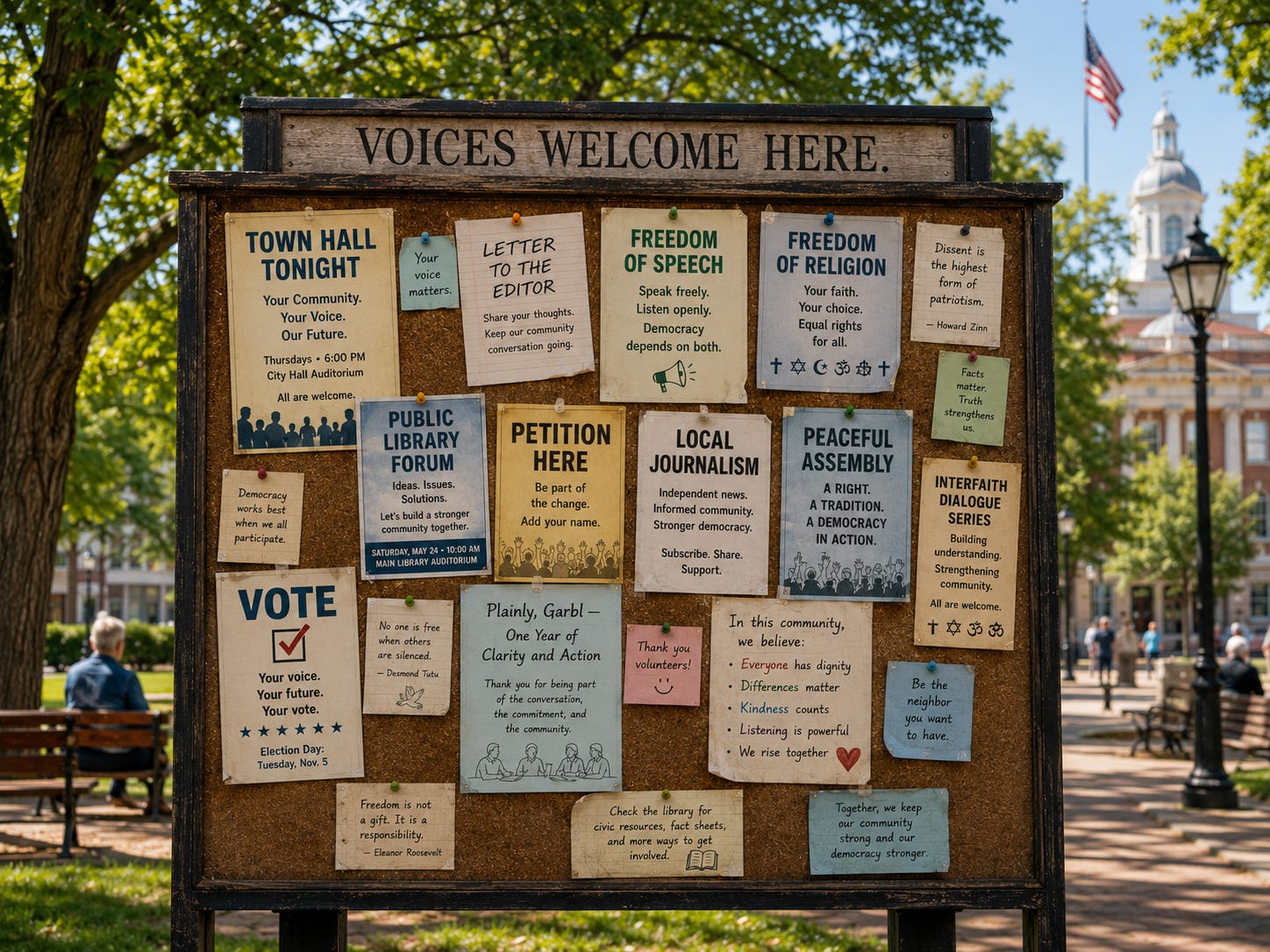
Plainly, Garbl went public on June 1, 2025, as a resource for clarity and action.
One year later, I still believe those two words belong together. Clear words help people understand what is happening. Clear action helps people do something about it.
That is why I keep coming back to the First Amendment—not as a slogan, not as a shield for every careless comment but as a set of freedoms that make democratic action possible.
The First Amendment is not just about saying what we think. It protects the civic tools people need to question power, share facts, gather with others, worship or not worship as they choose, and push government to do better.
In other words, it protects the space where citizenship happens.
Plainly, Garbl grew out of Informed Resistance, a social media group I started for people who wanted to stay informed and respond to political threats with facts, purpose, and practical action. This Substack site became a way to expand that work with advocacy resources, clear-writing guides, media literacy tools, commentary, playlists, and reminders that democracy is not a spectator sport.
But clear action depends on clear understanding.
A recent online discussion reminded me how often people invoke the First Amendment without really understanding what it does and does not do. That is not unusual. “Free speech” is one of the most familiar phrases in American public life. It is also one of the most misused.
The First Amendment says, “Congress shall make no law respecting an establishment of religion, or prohibiting the free exercise thereof; or abridging freedom of speech, or of the press; or the right of the people peaceably to assemble, and to petition the government for a redress of grievances.”
The First Amendment is mainly a limit on government power. It bars public officials from punishing, censoring, or retaliating against protected expression. It also protects the news media, religious liberty, peaceful assembly, and the right to ask the government to correct wrongs.
It does not turn every Facebook group, workplace, publication, or private organization into a constitutional courtroom.
A private online group can set rules for respectful discussion. A newspaper can choose what to publish. A business can enforce workplace standards. A community organization can reject bullying, threats, cruelty, and harassment. None of that automatically violates the First Amendment.
That does not mean every private rule is wise, fair, or well applied. Moderators can overreact. Employers can make bad decisions. Publishers can show poor judgment. Communities can be inconsistent.
But the constitutional question is narrower: Is the government restricting protected expression?
That distinction is important because it keeps us from confusing disagreement with censorship, moderation with tyranny, and consequences with constitutional violations.
There is another misunderstanding worth clearing up.
Some people talk about rights and laws as if they exist mainly to create punishment after someone acts. Say what you want. Do what you want. Accept the consequences (or not).
Consequences matter. But they are not the main purpose.
The larger purpose is prevention and protection. Constitutional rights are meant to prevent government abuse before damage is done. Laws against threats, fraud, harassment, stalking, and discrimination are meant to discourage harmful conduct before people are harmed.
Punishment is one enforcement tool. It is not the whole point.
That matters in a democracy because liberty and accountability have to work together. Freedom without responsibility can become intimidation by the loudest or most powerful people in the room. Rules without liberty can become censorship and control.
The hard work of democracy is holding both truths at once.
That is why the First Amendment should not be treated as a bumper sticker. It is a working tool of self-government.
It allows people to criticize public officials, investigate government decisions, gather in public protest, practice a faith or no faith, sign petitions, write letters, call elected officials, testify at public meetings, and demand answers.
It also protects speech that many of us find offensive, foolish, or wrong. That is part of the bargain. Government should not have the power to silence ideas simply because officials, or even majorities, dislike them.
But that does not relieve us of responsibility for how we use our freedoms:
We can defend free speech without excusing cruelty or bigotry.
We can protect dissent without spreading lies.
We can argue fiercely without making threats.
We can challenge power without dehumanizing people.
Those distinctions are not weakness. They are civic discipline.
For Plainly, Garbl, this is not an abstract issue. Clear writing, reliable information, independent journalism, public records, peaceful protest, advocacy, and practical citizenship all depend on First Amendment freedoms.
So do the people and organizations working every day for civil rights, environmental protection, peace, public health, education, local journalism, government accountability, and human dignity.
One year into this project, I am more convinced than ever that clear and truthful words matter. Not because words solve everything. They do not. But unclear, false, or deceitful words make almost everything worse.
If we want to defend freedom, democracy, and human dignity, we have to understand our rights, use them responsibly, and protect them before they are damaged.
That is the work ahead for Plainly, Garbl’s second year: clearer words, stronger action, and a continuing belief that democracy works best when people know their rights, respect the rights of others, and use those freedoms to build something better.
Site Directory for Plainly, Garbl:
A curated collection of guides, groups, and tools to help you speak out, stand strong, and stay informed.
Freedoms of Speech, Press & Assembly:
A ranked guide to organizations safeguarding free expression and civic participation.