
🟩 Protect What Still Protects Us
Laws, agencies, public lands, clean water, clean air, and climate safeguards need defending before the damage is done.

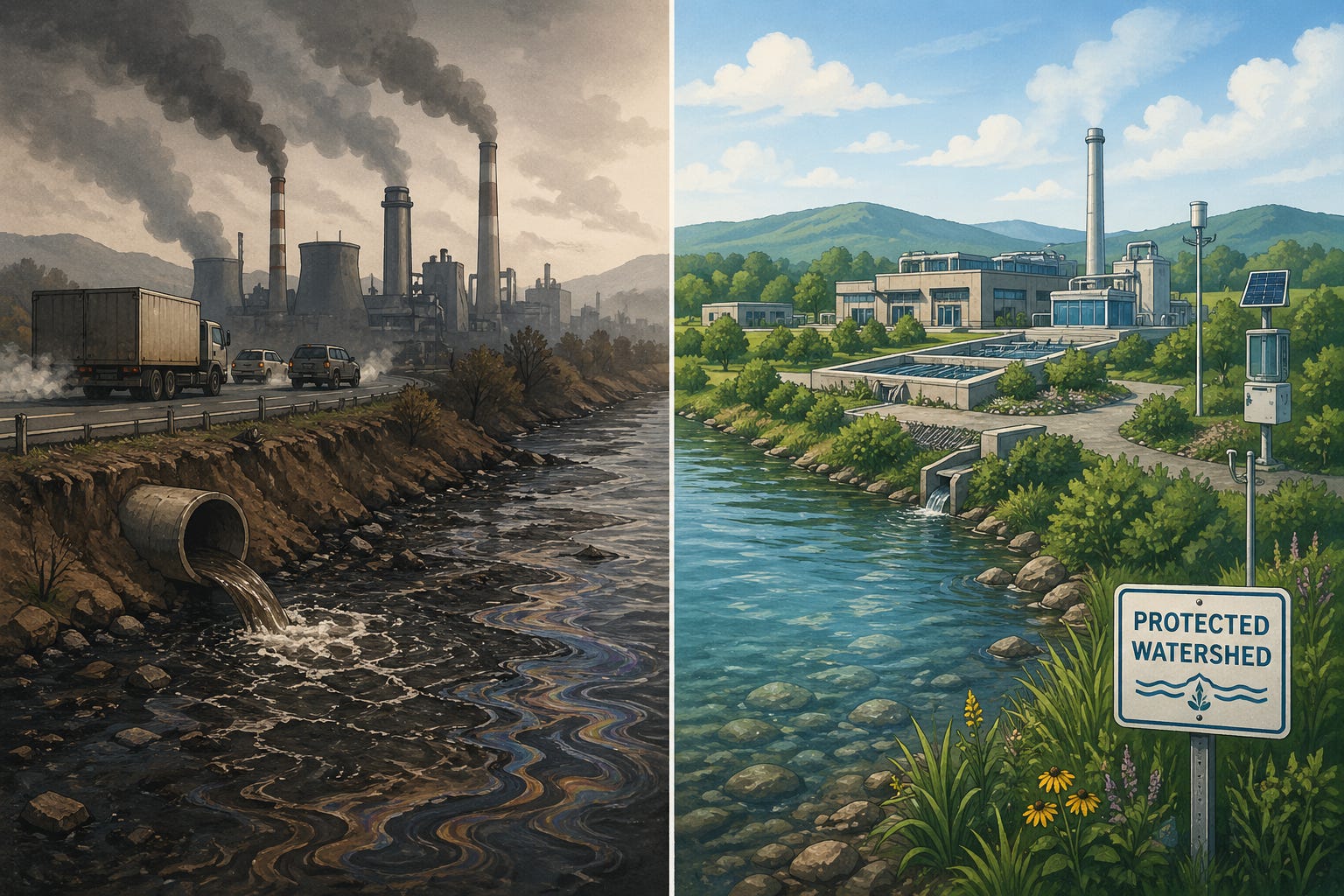
Environmental protection seems to have slipped from public urgency at the very moment it needs defending most.
Not environmental concern. Many people still care about clean air, clean water, public lands, wildlife, climate change, and the places they love.
Not environmental volunteerism. People still clean beaches, plant trees, restore habitat, recycle, conserve, and show up for local projects.
I mean protection: the harder work of defending laws, agencies, climate rules, shorelines, refuges, public lands, clean-air standards, clean-water rules, and public health safeguards before damage is done.
That concern came into sharper focus for me after Earth Day, when a friend challenged me to think harder about the difference between environmental restoration and environmental protection.
He was not attacking restoration. Neither am I. Restoration projects give people a way to take part, see results, build community, and draw attention to environmental care.
Damaged places need repair, and habitat work, cleanups, and native plantings give people practical ways to help.
But his larger worry stayed with me: Have we become more comfortable repairing damage than preventing it?
Repair is not prevention
Restoration repairs. Protection prevents.
A serious environmental movement needs both. But they are not the same. Restoration can heal a damaged shoreline, replant a forest, reconnect a river, or rebuild habitat.
Protection asks a harder question: What are we willing to defend before the damage happens?
That question is less comfortable because protection often creates conflict. It can mean source control—stopping pollution before it spreads—along with fighting destructive projects, confronting regulators, challenging business interests, questioning public bodies, and sometimes criticizing people or groups we otherwise respect.
That is where some of the old spirit seems to have faded.
Experts make the same point
Experts do not treat restoration as a substitute for protection. The United Nations’ restoration framework describes the goal as preventing, halting, and reversing ecosystem degradation. And that order matters. Prevention comes first.
The International Union for Conservation of Nature has made a similar point about forests: Restoring degraded areas is important, but it cannot replace protecting intact primary forests.
Climate change has not paused
Climate change also belongs in this discussion.
It has not gone away. It has been crowded out. Public attention is scattered by threats to democracy, war, prices, immigration fights, culture-war conflict, and the daily turbulence of Trump-era politics.
But fires, floods, drought, erosion, heat, sea-level rise, damaged habitat, and polluted air do not pause because the news cycle is exhausted.
Climate change has become oddly normalized in the U.S. Its impacts are no longer shocking enough. They risk becoming background scenery in a country overwhelmed by crisis.
Yale and George Mason’s fall 2025 climate survey found that 64% of Americans are at least somewhat worried about global warming, including 29% who are very worried.
But the same research found that only 39% hear about global warming in the media about once a month or more; only 23% hear about it on social media that often; and only 14% hear people they know talk about it that often.
Concern remains. Public conversation lags.
Cutting greenhouse gas emissions remains essential. But environmental protection is also climate work. Protecting forests, wetlands, shorelines, watersheds, public lands, and wildlife refuges helps store carbon, reduce flooding, cool communities, protect drinking water, and give natural systems a fighting chance.
EPA: Protection is in the name
The U.S. Environmental Protection Agency began operating on Dec. 2, 1970, during the Nixon administration.
Its name still matters. It was called the Environmental Protection Agency because the country had finally recognized that clean air, clean water, public health, and natural systems needed national protection.
That was true 55 years ago when I was a college sophomore and seeking causes to support. It is more urgent now.
The irony is bitter. An agency created under a Republican president is now being undermined under another Republican president.
The Trump administration is weakening federal environmental protections. Climate rules are under attack. And other agencies created to safeguard public health and natural resources are being hollowed out.
In February 2026, EPA finalized its rescission of the 2009 greenhouse-gas endangerment finding. That finding had served as the legal prerequisite for regulating greenhouse gas emissions from new motor vehicles and engines under that part of the Clean Air Act.
Buried under the daily storm
Part of the problem is attention. Trump dominates the political weather. Daily outrage crowds out long-term threats.
Environmental protection is competing with everything else: democratic breakdown, court decisions, immigration fights, foreign conflicts, economic anxiety, public safety, and the daily presidential spectacle.
But environmental protection is not separate from those fights. It is part of the same question:
Do public safeguards still matter?
Do laws still matter?
Do agencies still serve the public?
Does science still guide policy?
Does the government still protect people and places that cannot protect themselves?
Put protection back in front
Environmental restoration is still necessary. So are cleanups, recycling, conservation, public education, local projects, and practical hope.
But the environmental movement also needs its protective backbone.
The EPA was created because the country recognized that clean air, clean water, public health, wildlife, and the natural world could not be left to goodwill, profit, or local politics alone. That remains true.
If we care about the environment, we cannot only repair damage after the fact. We must also defend the protections that prevent damage in the first place.
That is the work in front of us now.
Related commentary: This piece follows my earlier Earth Day reflection, “Earth Day Is a Reminder, Not a Ritual,” shifting from environmental care and awareness to the harder work of defending protections before damage is done.
Resources for action
Environmental Protection & Climate Action
A ranked guide to groups fighting pollution, defending ecosystems, and promoting climate solutions.
Energy Conservation & Climate-Smart Energy
A ranked guide to organizations supporting renewable energy, decarbonization, and energy justice.
Environmental Justice and Community Resilience
A ranked guide to advocacy groups helping communities confront pollution and build climate resilience.
National Parks, Public Lands & Natural Resources
A guide to advocacy groups protecting public lands, conserving natural resources, and expanding environmental access for all.