
✍️ It Ain’t All About Taxes
What we ask government to do and what we’re willing to pay for

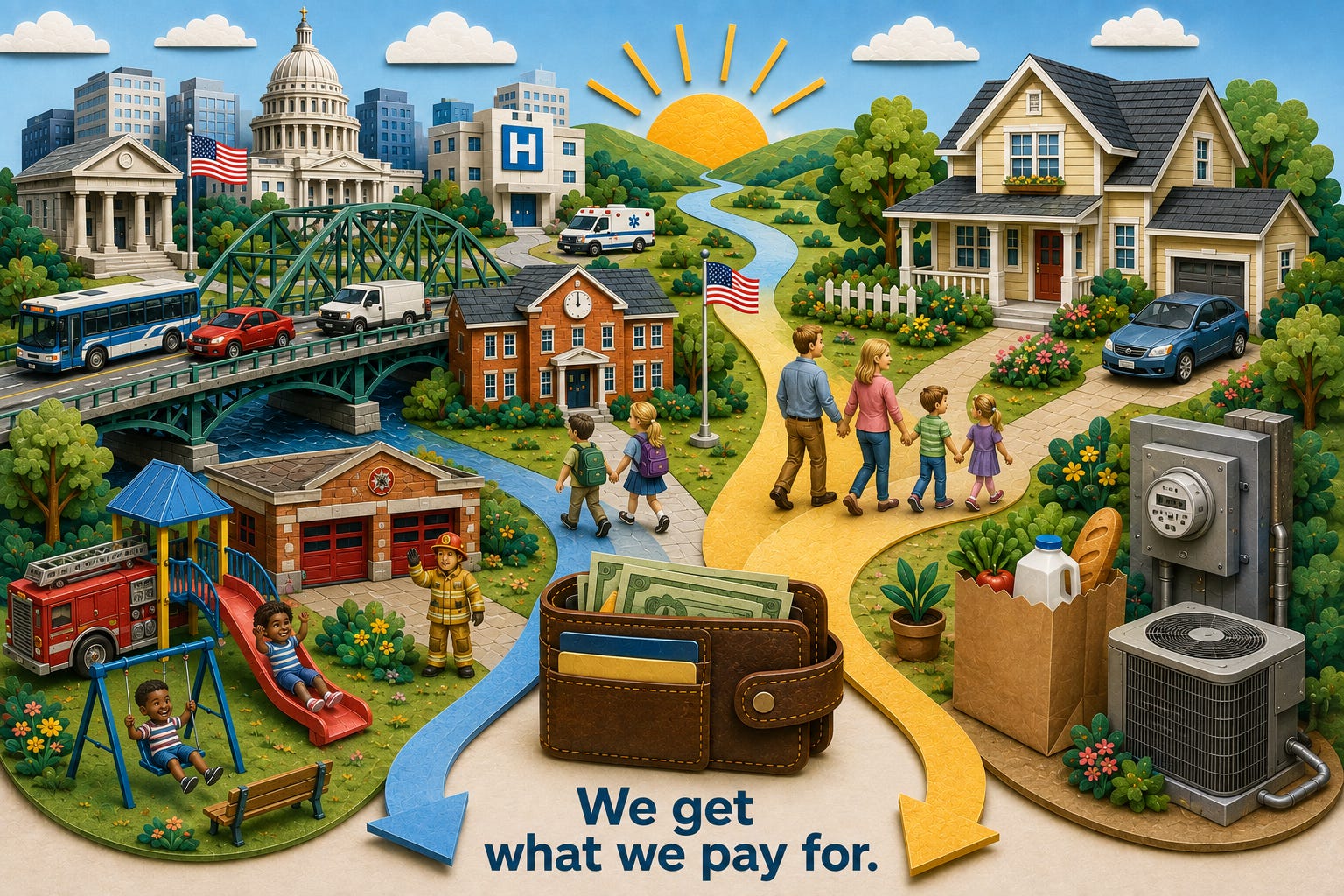
Benjamin Franklin knew a good line when he wrote one.
“Our new Constitution is now established,” he wrote in 1789, “and has an appearance that promises permanency; but in this world nothing can be said to be certain, except death and taxes.”
More than two centuries later, taxes may be just as certain—and probably no more popular.
Few of us enjoy watching money disappear from a paycheck or writing a check to the Internal Revenue Service. We may not like watching it disappear to have moss removed from a high roof either. (I certainly didn’t, but it had to be done.)
Politicians know that. “Tax” has become one of those words that can almost make its own political argument.
But another famous quotation asks us to look at taxes differently.
In a 1927 Supreme Court opinion, Justice Oliver Wendell Holmes Jr. wrote: “Taxes are what we pay for civilized society.”
That gets closer to the point. And, come to think of it, the moss removal.
What are we paying for?
The U.S. Constitution offers an answer almost immediately.
Article I establishes Congress. Then Section 8 lists its powers. The first one is the power to “lay and collect Taxes, Duties, Imposts and Excises, to pay the Debts and provide for the common Defence and general Welfare of the United States.”
Taxation comes before regulating interstate commerce, establishing rules for naturalization, coining money, creating post offices, declaring war, raising armies, and maintaining a navy.
By 1787, the experience under the Articles of Confederation, adopted 10 years earlier, had shown why taxation mattered. The national government could not levy taxes directly. Congress could ask the states for money, but it could not require them to provide it.
Americans learned that creating a government without giving it reliable ways to pay its bills wasn’t much of a government.
The replacement Constitution changed that.
The people who had fought a revolution in which taxation played a central role created a new national government with substantial taxing authority.
The lesson was not that taxation itself was tyranny.
The question was who had the legitimate authority to impose taxes, for what purposes, and under what system of representative government.
Those questions haven’t gone away.
It ain’t all about taxes
I’ve reached a similar conclusion about another subject I’ve been writing about: the presidency.
It ain’t all about the president.
Government is much larger than one person, even one holding its most visible office. What matters are the policies we want government to adopt, which parts of government have the authority to adopt them, and what those policies accomplish.
It’s about what we want government to do and how we pay for it.
We want roads and bridges that don’t fall apart. Safe drinking water. Schools. Courts. Police and firefighters. Emergency response. National defense. Parks. Elections. Public health. Environmental protection. Social Security and Medicare.
We expect government to inspect food and medicine, forecast hurricanes, manage air traffic, enforce contracts, protect property rights, respond to disasters, and perform countless other jobs that most of us barely notice until something goes wrong.
We can argue—and should—about every item on that list.
Maybe government should do more. Maybe it should do less. Some programs work well. Others don’t. Some spending is wasteful. Some taxes are unfair. Some people and businesses may pay too much, while others pay far too little.
Those are legitimate political arguments. But they are arguments about choices, not simply about taxes.
The bill still arrives
Politicians of every ideology offer solutions to the problems we face. Whatever the proposal, somebody has to pay for it.
When elected leaders, businesses, or interest groups propose new programs or expanded services, we should ask:
How are we going to pay for them?
Government can raise taxes. It can borrow money. It can cut something else. It can shift costs to states, local governments, businesses, or individuals.
But the cost doesn’t disappear.
The same standard should apply in the other direction. When politicians, businesses, or interest groups propose cutting taxes, we should also ask:
What comes with the cut?
What will government stop doing? What will it do less of? What will it borrow to continue doing? Who else will pay?
That isn’t anti-tax or pro-tax. It’s accountability.
What are we willing to pay for?
That brings me back to Holmes.
“Civilized society” isn’t an abstraction. It includes the things we decide people should be able to rely on and the responsibilities we assign to government.
Those decisions are political. So are the decisions about paying for them.
Franklin was right that taxes are inevitable. But Holmes asked us, in effect, to consider what we get in return.
So perhaps our political arguments shouldn’t begin with whether taxes should go up or down.
They should begin here: What do we want our government to do?
And then: What are we willing to pay for it?