
📰 If You’re Concerned About Bias, Check for Accuracy
How to read the news without losing trust in the facts

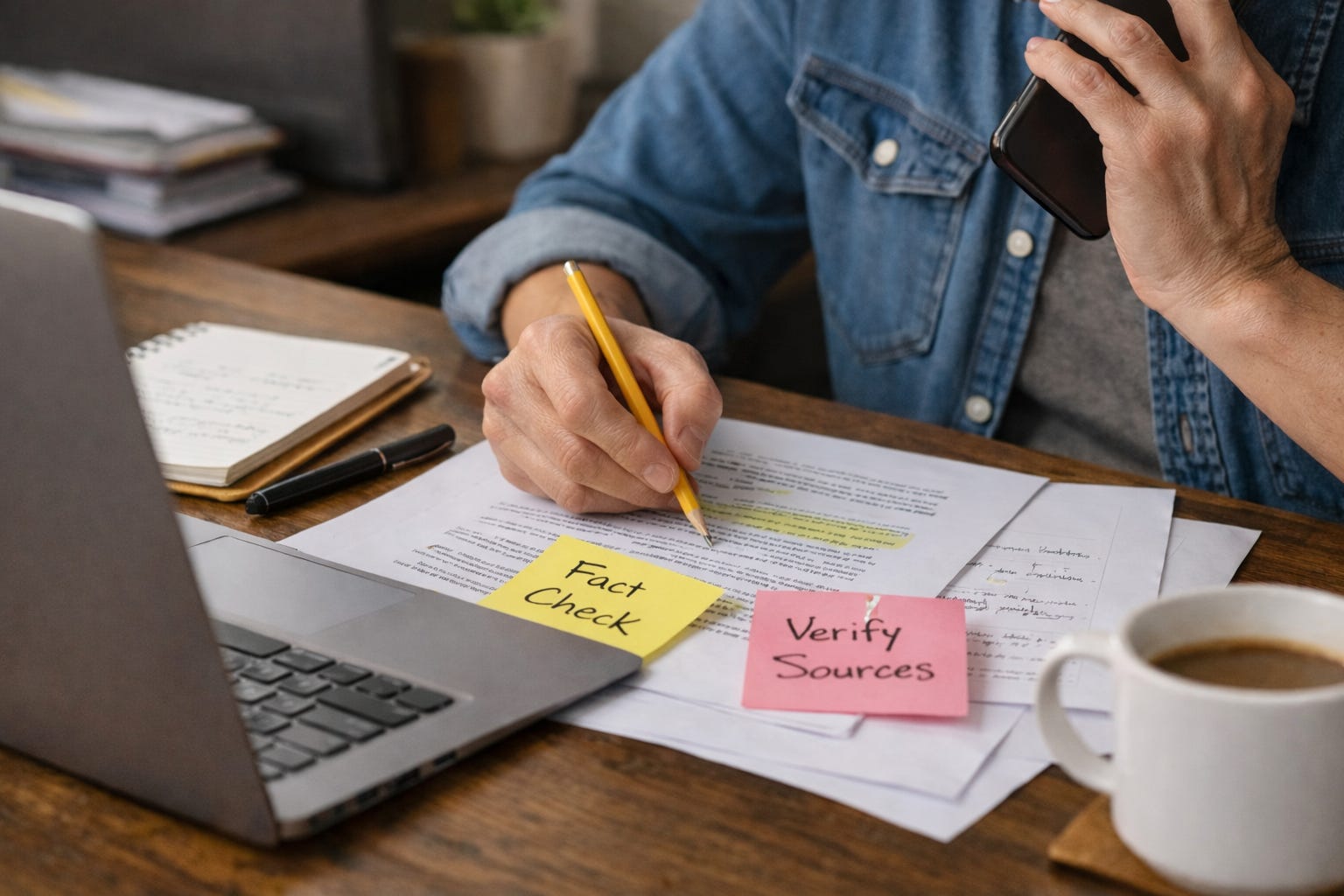
Discussions about media bias often get stuck on familiar terms: objectivity, fairness, balance. Those values matter. But they rest on something more basic and more important.
Accuracy.
Accuracy is the foundation of journalism. Without it, objectivity becomes meaningless; balance turns into false equivalence; and fairness becomes a performance rather than a standard.
Facts are facts. There is no such thing as “true facts” or “alternative facts.” There are facts, interpretations of facts, and sometimes claims that do not hold up.
Understanding that distinction is one of the most useful skills a news reader can develop.
Bias is not the opposite of accuracy
One common misunderstanding is the idea that if reporting is factual, it must be unbiased—or that bias automatically means dishonesty.
Neither is true.
All journalism involves judgment:
Which stories are covered
Which facts are emphasized
Which voices are quoted
How much context is provided
Those choices reflect values and perspectives. That’s what people usually mean by left, right, or centrist in news writing and analysis. These labels describe patterns of framing, not whether facts are invented.
Bias does not require lying.
And accuracy does not require neutrality.
For example, I approach this topic from a progressive perspective. That lens shapes how I notice news angles and viewpoints, but it does not diminish my attention to whether the reporting is accurate.
What competent reporting actually tries to do
Reporters routinely work under time pressure, competing claims, incomplete information, and evolving facts—while still expected to verify what can be verified and say clearly what cannot.
When reporters are doing their jobs well, they are not simply “covering both sides.”
They are also:
Checking claims against available evidence
Questioning sources when the information does not add up
Following up to verify or correct details
Reporting when claims cannot be independently confirmed
Naming misinformation (inaccurate information) or disinformation (deliberately false or misleading information, aka lies) when appropriate
Providing accurate clarifications and details
This work is often invisible to readers. You usually see only the final version, not the phone calls, emails, documents, and corrections that shaped it. And it’s often done on deadline within hours—or a day or two if it’s not breaking news.
That does not mean journalism is flawless. It does mean that verification—not balance for its own sake—is a professional obligation.
Objectivity, fairness, and balance, used carefully
These traditional values still matter, but they are often misunderstood.
Objectivity does not mean having no point of view. It means approaching reporting with discipline, evidence, and openness to correction.
Fairness does not mean treating all claims as equally credible.
Balance does not mean giving equal weight to unequal evidence.
Accuracy comes first. Everything else depends on it.
Trust—but don’t outsource your judgment
Trust here doesn’t mean believing everything you read. Or that you should simply trust that reporters always get it right. It means understanding how facts are established and how to judge them for yourself.
A healthy approach sits between blind trust and blanket cynicism:
On issues that really matter to you, check more than one reliable source.
Notice where outlets agree on facts but differ in emphasis or interpretation.
Pay attention to corrections, sourcing, and transparency.
Doing this is not distrust. It is engagement.
Tools that help readers check media for accuracy, bias, and reliability
Various online tools can help readers check news accuracy and better understand media credibility, if used thoughtfully.
These tools don’t tell you what to think. They help you see how information is presented, what standards are being applied, and what questions to ask next.
No single rating or chart can settle everything. The real value comes from understanding what each tool measures and what it does not.
Specific tools and Plainly, Garbl resource links appear at the end of this piece for readers who want to put this approach into practice.
A practical reader’s checklist
So, when reading or watching news, especially analysis or commentary, try asking:
What claims here are factual, and what is interpretation?
What evidence is cited, and what are the sources of information?
What context is included or missing?
Is uncertainty acknowledged where facts are unclear?
Does the outlet correct errors publicly?
And one more question worth asking: How do your own biases affect how you react to how a news article reports the facts?
These questions work regardless of whether a source leans left, right, or somewhere in between—or skews further in one direction.
Why this matters
Claims that “all media are biased” can slide quickly into “nothing is knowable.” That way lies cynicism and disengagement.
A better approach is simpler:
Expect accuracy.
Recognize perspective.
Verify what matters.
Stay engaged.
Recognizing how journalism works—at its best and at its limits—makes readers stronger, not more suspicious.
And in an era when misinformation and disinformation circulate freely, that strength matters.
Related tools and resources
For readers who want to apply the approach described above, the following tools and guides can help.
For fact-checking, I use FactCheck.org and PolitiFact. For evaluating media bias, reliability, and credibility, I use Ad Fontes Media and NewsGuard.
These resources are most useful when used together—and when readers understand what each one measures and what it does not.
I encourage you to learn more about those tools and others at these Plainly, Garbl resources:
Evaluating the Evaluators: A Guide to Media Analysis & Bias Rating Resources
Understanding the watchdogs that track journalism’s trustworthinessThe Truth Toolkit: Fact-Checking Resources for Informed Resistance
Understanding where to find reliable fact-checking resources is more critical than ever.
For guidance on choosing multiple news sources—including progressive, moderate, conservative, nonprofit, and local outlets—see the Media & Journalism Tools section. I use the resources above to help evaluate, monitor, and recommend the news media I rely on.
If this resource resonates with you, please share it with friends.
Get new posts from Plainly, Garbl delivered to your inbox.