
✍️ Freedom Needs a Free Press. And a Public That Pays Attention.
On the 250th anniversary of the Declaration of Independence, media literacy is part of the work of democracy.

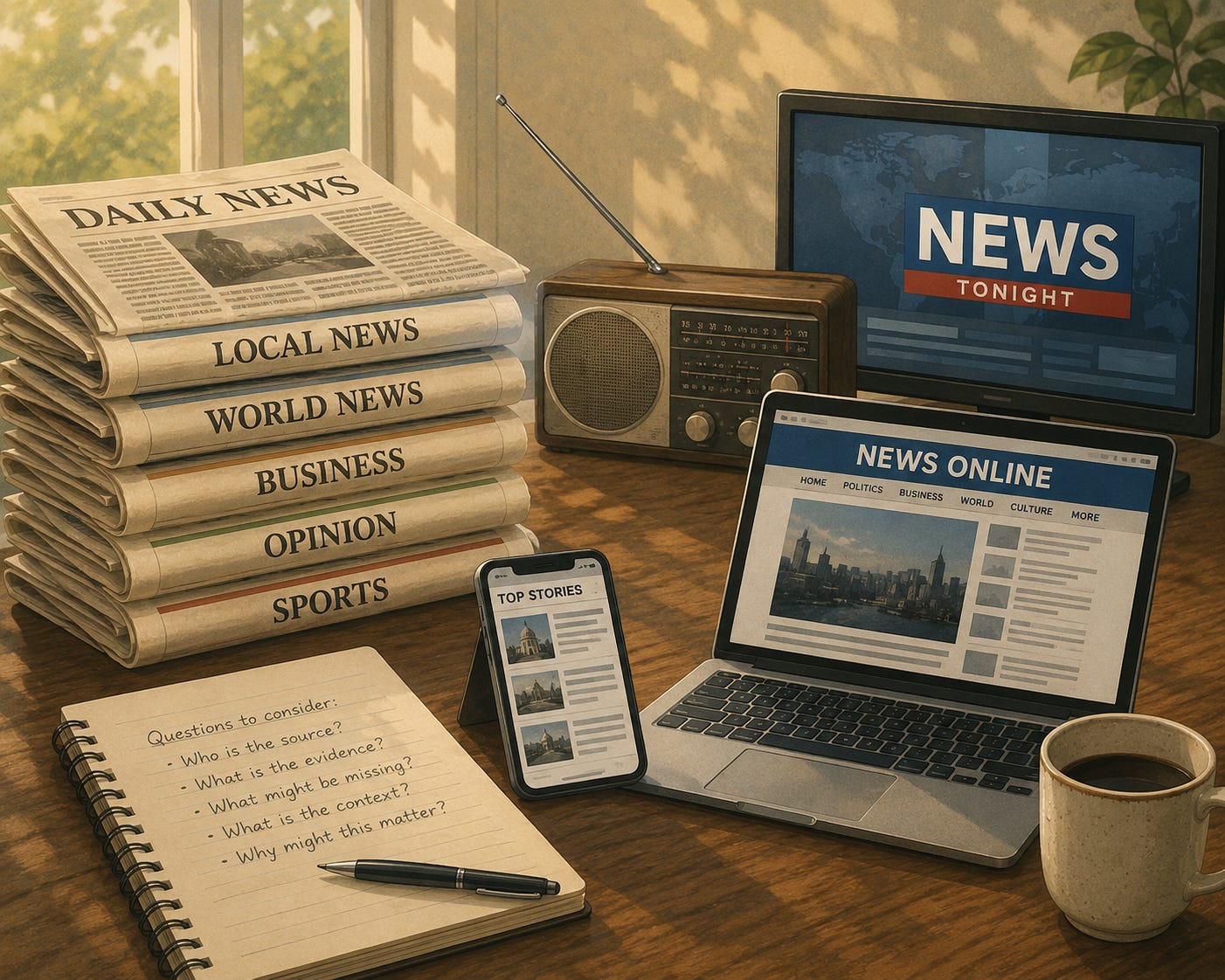
This Fourth of July is more than a milestone. It is a checkpoint.
Two and a half centuries after the Declaration of Independence, Americans are still arguing over the responsibilities of government, who gets heard, who gets believed, who gets power, and how truth survives in public life.
That argument is not a failure of democracy. It is part of democracy, when it is grounded in facts, open debate, public accountability, and the freedom to challenge those who govern in our name.
I care about this partly because of my experience working as a journalist and with journalists. I still think like one: Check the claim, look for evidence, ask what’s missing, and correct the record when needed. I also care because I’ve seen up close how local government and civic action depend on people knowing what is actually happening around them.
The First Amendment protects more than expression. It protects the rights that make democracy possible without government control: freedom of speech, freedom of the press, freedom of assembly, freedom to petition the government, and freedom of religion.
Those freedoms allow people to question authority, expose wrongdoing, gather in public, organize for change, worship or not worship, publish unpopular ideas, and demand answers from public officials.
But freedom does not inform, verify, or defend itself.
An independent free press helps communities see what power is doing. But that promise weakens when local newsrooms shrink or disappear after advertising revenue flows to online platforms and distant corporate owners. Fewer reporters are left to cover school boards, courthouses, city councils, statehouses, and local issues that shape daily life.
When verified reporting fades, communities are left with more noise, more rumor, and fewer shared facts.
A free society needs more than speech. It needs people who know how to judge what they read, hear, watch, and share.
That does not mean trusting every headline. It does not mean pretending all news sources are equally reliable. And it does not mean retreating into cynicism by declaring that “all media are biased,” as if that settles anything.
Bias matters. But calling something biased is not the same as checking whether it is accurate.
Facts are not left, right, or center. Interpretations may differ. Emphasis may differ. Values may differ. But claims still need evidence, sources still need scrutiny, and corrections still need to be made when the record is wrong.
Media Literacy Tools
I’m using this Fourth of July to highlight Plainly, Garbl’s Media and Journalism Tools. I list a few of the tools below.
The point is not to tell readers what to think. It is to help readers test claims, recognize bias, judge accuracy, support independent journalism, and choose news sources with care.
A free country needs free expression. It also needs citizens who know how to sort evidence from assertion, reporting from opinion, skepticism from cynicism, and facts from fog.
These resources are meant to help readers defend facts, understand media bias, spot disinformation, evaluate news sources, and support independent journalism.
A few key resources:
If You’re Concerned About Bias, Check for Accuracy
A plain-language essay on why accuracy is the foundation of journalism—and why bias is not the same thing as dishonesty.
The Truth Toolkit: Fact-Checking Resources for Informed Resistance
A guide to credible fact-checking organizations and practical ways to verify questionable claims.
Evaluating the Evaluators: A Guide to Media Analysis and Bias Rating Resources
A guide to tools that rate media credibility, reliability, accuracy, and bias—and how to use them without outsourcing your judgment.
Saving Local Journalism and Independent Media Advocacy
A guide to organizations working to rebuild local journalism, defend press freedom, support nonprofit and independent newsrooms, and strengthen community-based news.
Progressive Media Sources for News, Ideas, and Action
A guide to fact-based journalism and analysis from a progressive perspective.
Other guides at Media and Journalism Tools include moderate and conservative media, Pacific Northwest media, nonprofit newsrooms, credible topic-based sources, and trusted commentators.
Related advocacy group resources at Plainly, Garbl cover all First Amendment freedoms and more. This spotlight focuses on the news media and journalism tools that help people use those freedoms with care.
The work does not end with the links.
The promise of the First Amendment is not passive. It asks something of us.
Read carefully. Check facts. Support journalism. Listen across differences. Speak honestly. Correct mistakes. Defend the right of others to question power, even when their questions make power uncomfortable.
After 250 years, the work of self-government is still unfinished.
Good.
That means it is still ours.