

I get it. The daily outrages are exhausting. They’re meant to be.
Outrage fatigue isn’t a personal failing. It’s a political strategy. When people are overwhelmed, they might disengage. When they disengage, damage accelerates quietly, without resistance.
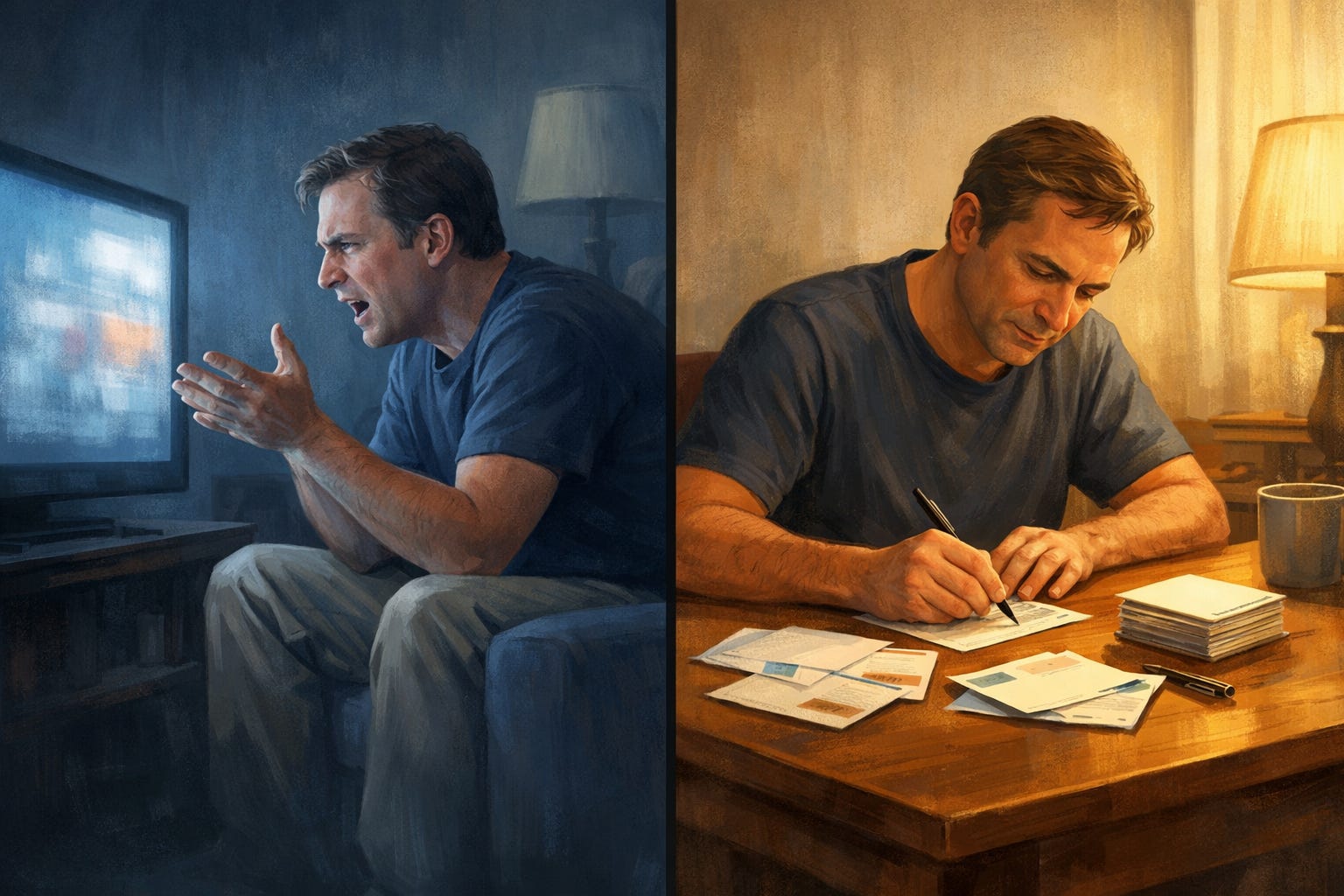
If you find yourself yelling at your TV these days—angry, upset, frustrated—you’re not alone. But you’re also not doing anything that changes what happens next.
To be blunt: I know that yelling may feel satisfying, but it’s a waste of energy. And, more importantly, it’s a waste of time.
The people causing the damage can’t hear you. The institutions that matter aren’t affected by it. And the only thing it reliably produces is more exhaustion.
By “yelling at the TV,” I don’t just mean that single act. I mean all the ways our frustration gets burned off without being directed—venting, stewing, doomscrolling, or lashing out. They may release emotion, but they don’t change outcomes.
There are things we can do, by ourselves and with others, that can affect what’s happening. They’re quieter than shouting. They’re less satisfying in the moment. But they matter.
Pressure works when it’s directed: toward elected officials, toward institutions, toward narratives that are being normalized, and toward elections that we can influence before campaign ads flood the airwaves.
Trading outrage for action isn’t about going numb. It’s about choosing effectiveness over catharsis.
That’s why I’m uneasy with the idea that the only response to the current madness is “just focus on the 2026 election.” Voting matters enormously. Elections can stop the damage. But they do not prevent it.
Democracies don’t fall apart on Election Day. They erode on ordinary Tuesdays.
The false choice we’re being offered
We’re often presented with a bad choice:
Option A: Stay informed, stay angry, burn out.
Option B: Tune out, protect your sanity, wait for the midterms.
That’s a false choice. The real option—the one authoritarians fear—is sustained, ordinary pressure that doesn’t rely on rage or viral moments.
Not screaming. Not doomscrolling. Not waiting politely.
Some readers may recognize this argument. Last year, I wrote that We Must Walk and Chew Gum at the Same Time: Defend democracy now while preparing for the 2026 and 2028 elections. I still believe that. If anything, events since then have made it more obvious, not less.
There’s also a fair concern underneath this debate: Constant attention to political damage can make people anxious, angry, and numb. Stepping back to enjoy life, protect mental health, and reconnect with community isn’t indulgent. It’s necessary.
Stepping back doesn’t have to mean stepping out.
I don’t live in a permanent state of outrage. I write. I take photographs and make music. I volunteer. I spend time with people I love. I share resources for resilience and inspiration in Plainly, Garbl:
Sustainable engagement requires an inner life, not just a political one. Taking care of ourselves is not an alternative to civic responsibility. It’s what makes long-term responsibility possible.
Not everyone has the same capacity at the same moment—and that’s OK. Democracy needs sprinters, walkers, note-takers, and people who keep the lights on.
One reason I started building resources like Plainly, Garbl was to help people do more than yell at their TVs.
Anger is understandable. What’s happening deserves a response. But outrage without direction just drains people. I wanted to help channel that energy into something that matters.
That’s why so much of Plainly, Garbl focuses on advocacy group resources, government tools, and practical ways to engage, not just commentary. The writing is part of the project, but it was never the point by itself.
The point is action.
If my work here does its job, it doesn’t just validate frustration. It moves people toward tools that turn frustration into pressure.
Pressure.
What “pressure” looks like (before the 2026 midterms)
This doesn’t require heroics. It requires consistency.
1. Pressure on institutions
Elected officials notice patterns, not isolated actions.
Calls. Letters. Organized public demonstrations. Public comments. Oversight demands. Support for organizations that file lawsuits, force disclosures, and slow reckless actions. None of this is glamorous. All of it matters.
Silence doesn’t calm chaos. It trains it.
2. Pressure on the narrative
This is where writers, readers, and ordinary citizens still have power.
Correct the record. Call out normalized lies. Share credible reporting. Refuse to let outrageous behavior become background noise.
Memory is a form of resistance.
3. Pressure through early, strategic electoral work
Yes, vote.
But also organize before the campaign season becomes a media circus.
Many of us live in states or districts where our preferred candidates are safe. That doesn’t mean we’re sidelined. It means we’re free to help where the margin is thin.
I recently attended a meeting of the local Indivisible in Port Townsend, Washington. A guest speaker described how his organization coordinates postcard-writing campaigns nationwide and other targeted efforts to support candidates in competitive districts and states.
That’s not symbolic. That’s math.
Midterms aren’t won in October. They’re won when vulnerable incumbents realize early that people are paying attention and that challengers have support.
I’m all in on that work this year. Not someday. Not “after things settle down.” Now.
Why waiting is risky
The idea that we can simply endure the present and fix everything at the ballot box later ignores a hard truth: Unchecked power rarely waits patiently for elections.
The damage done before the midterms will shape what’s possible after 2026—legally, institutionally, and culturally. Pressure now limits how far things can slide.
Voting is the fire extinguisher. Pressure is the fire alarm. We need both, or the building burns before Election Day.
Plainly put
Early action doesn’t require constant worry. In fact, it often reduces it. When people take small, concrete steps—supporting candidates who need help, writing postcards, joining coordinated efforts—they regain a sense of agency. That steadies the mind more than avoidance ever does.
This isn’t about staying angry. It’s about staying engaged without burning out.
I don’t believe we need to choose between enjoying life and defending democracy. We need to do both, imperfectly, sustainably, and together.
Where to put this energy
If you’re looking for ways to turn frustration into pressure, here are a few places to start—whether you want to act locally, nationally, or both:
Indivisible—Local and national organizing, including calls, postcards, and public demonstrations
MoveOn—Coordinated campaigns that translate public concern into sustained action
ACLU—Legal pressure and defense of constitutional rights
RepresentUs—Structural reform and accountability
Supporting Liberal, Progressive, Democratic Officeholders & Candidates—A guide at Plainly, Garbl to groups that help strengthen Democratic power and candidates who need it most
Also at Plainly, Garbl, I’ve gathered a Library of Advocacy Resources with other organizations, government guides, and action tools for readers who want to go deeper.
Vote!
Support candidates who need help, even if they’re not in your district.
Apply steady pressure to elected officials, the media, and each other.
Democracy isn’t maintained by hope alone. It’s maintained by people who don’t look away just because the calendar says the election is months off.
If this commentary resonates with you, please share it with friends.
Get new posts from Plainly, Garbl delivered to your inbox.
Thanks for this. I shared it with friends on Facebook.