

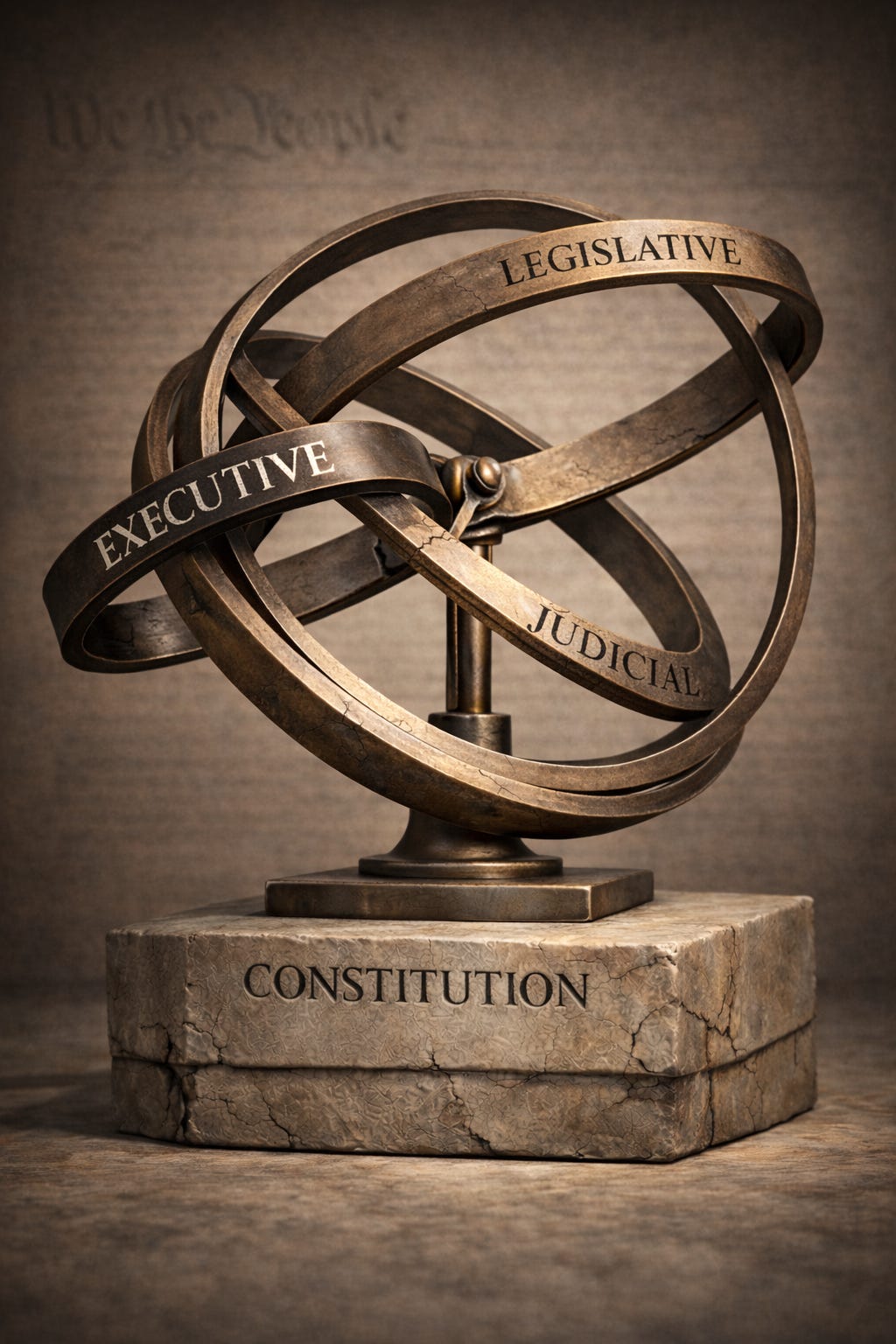
The U.S. system of government is often described as complex. At its core, however, its structure rests on a straightforward idea: Power should restrain power.
Three coequal branches—executive, legislative, and judicial—are meant to limit and restrain one another. Not through constant conflict but through mutual respect for boundaries set by the Constitution. The system works not because any one branch is dominant but because none is supposed to be.
That balance depends on restraint:
Lawmakers willing to use their constitutional powers rather than surrender them.
Courts willing to enforce limits rather than bend to pressure.
Executives willing to govern within the law rather than test how far power can be stretched.
And it depends on a shared understanding that the Constitution is not an inconvenience. It is the framework that gives each branch and our government legitimacy.
When that restraint is abandoned, the system does not collapse all at once. It still looks familiar. The structures remain. The language persists. But the balance begins to fail. And the signs become visible to journalists, to institutions, and to citizens paying attention.
What we are witnessing now is not ordinary disagreement or healthy tension among branches of government. It is the erosion of checks and balances by one party and one ideology, acting in concert across all three branches.
Power is no longer checked; it is consolidated. Limits are no longer enforced; they are treated as obstacles rather than obligations.
In moments like this, democratic systems weaken not all at once but through steady distortion. When mutual restraint gives way to loyalty, the system tilts.
Balance is not automatic. It must be respected.
And when it is abandoned, the consequences are not abstract. They are structural.
Events of the past few days underscore how quickly abandoned restraint becomes action.
If this commentary resonates with you, please share it with friends.
Get new posts from Plainly, Garbl delivered to your inbox.